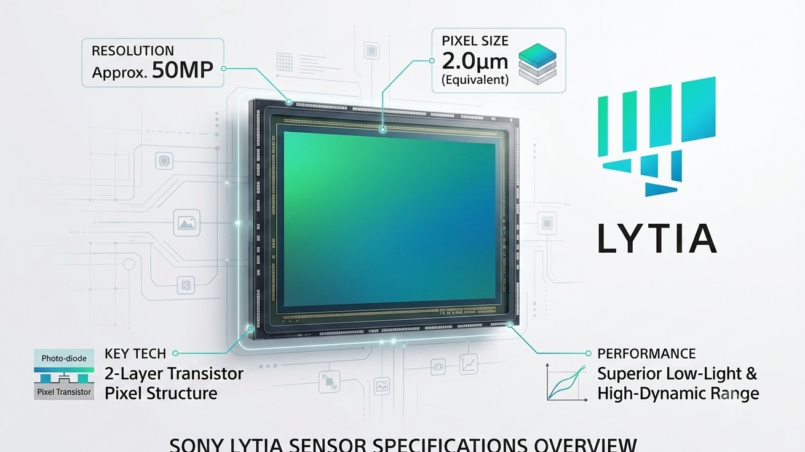
The Sony LYTIA L910 is a 50-megapixel stacked CMOS image sensor designed to improve smartphone photography in scenes with extreme differences between bright highlights and dark shadows. Announced by Sony Semiconductor Solutions on June 17, 2026, it is the first sensor in the LYTIA lineup to use LOFIC architecture. Its headline feature is a claimed 100 dB of dynamic range from a single exposure, alongside lower noise and support for 4K HDR video at 60fps.
The announcement matters because smartphone cameras often rely on multi-frame processing to capture high-dynamic-range photos. That approach can produce excellent results, but movement between exposures may introduce ghosting, blur, or flicker artifacts. The Sony LYTIA L910 sensor is designed to reduce those problems by capturing the required HDR information from one exposure.
Sony scheduled mass-production shipments for summer 2026. However, the company has not identified specific smartphone models using the sensor in its announcement. Its technical capabilities are promising, but the final image quality will also depend on the lens, image signal processor, and software used by each phone manufacturer.
The Problem With How Phone HDR Works Today
High dynamic range, or HDR, helps a camera preserve detail across bright and dark parts of a scene. For example, a smartphone photographing a person standing in front of a bright window needs to retain detail in the person’s face without turning the window into a featureless white patch.
Many smartphone imaging systems use multiple exposures or other computational techniques to balance these differences. The phone combines image information to produce a final photograph with a wider apparent range of tones than a single conventional capture might preserve.
The challenge is movement. If a person walks through the frame, a vehicle passes, or an LED light changes between captures, the images may not align perfectly. Processing can reduce these problems, but it cannot always eliminate them. The results may include ghosting around moving objects, softened detail, or flickering artifacts under certain lighting conditions.
The LYTIA L910 takes a different approach. Its LOFIC structure and Triple Conversion Gain-HDR technology are designed to capture a broad range of brightness levels from one exposure. Because the HDR information does not depend on merging separate exposure events, the approach can reduce motion-related artifacts associated with multi-exposure HDR.
That does not mean every image will be free of blur or flicker. Subject movement during an exposure, rolling-shutter behavior, lighting frequency, and the phone’s processing can still affect results. The advantage is that the sensor reduces one important source of HDR artifacts at the hardware level.
The LOFIC capacitor sits laterally beside each photodiode. When the photodiode fills up with light, excess charge flows into the capacitor rather than being lost. This dramatically expands the sensor’s saturation capacity without requiring a larger pixel.
Three Technologies Working Together
The L910 achieves its 100 dB figure through three layered technologies working in concert. First, LOFIC is the structural foundation. Each pixel has a lateral capacitor beside the photodiode. Excess charge that would normally saturate the pixel and create blown highlights flows into that capacitor instead. This expands the full well capacity without needing a physically larger pixel.
On top of that sits Triple Conversion Gain HDR (TCG-HDR). After a single exposure, the sensor reads the stored charge three times: once for bright highlights, once for midtones, and once for deep shadows. These three reads then combine into one full-range image, all without a second shutter event.
Finally, Ultra High Conversion Gain (UHCG) circuits handle the shadow end. These improve how efficiently the sensor converts charge into a measurable voltage signal. According to Sony, random noise in dark image areas drops by approximately 30% compared to the LYT-828.
How LOFIC preserves bright highlights
LOFIC stands for Lateral Overflow Integration Capacitor. In a conventional pixel, a photodiode converts incoming light into electrical charge. When the amount of charge exceeds its capacity, highlight information can be lost through saturation.
A LOFIC pixel includes an additional capacitor beside the photodiode. When the photodiode receives more light than it can hold, excess charge can be stored in this capacitor instead of being discarded. This increases the pixel’s effective charge-storage capacity and helps preserve information in very bright areas.
The benefit is particularly relevant to night scenes containing bright signs, headlights, streetlights, or LED displays against dark surroundings. By retaining more highlight information, the sensor has more data available for producing a balanced image.
Sony says the LYTIA L910 combines this structure with HDR readout and noise-reduction circuitry to deliver 100 dB of dynamic range in a single exposure. The result is a hardware-based improvement rather than simply a software effect applied after capture.
Together, these technologies aim to reduce highlight clipping, preserve shadow detail, and improve image quality without relying on multiple exposure events.
Three conversion gain reads from a single exposure, combined into one 100 dB image. No second capture event means no possibility of frame-to-frame subject movement introducing artifacts.
| Sensor Type Stacked CMOS – 1/1.28 Type – 12.49mm diagonal | Resolution ~50 effective megapixels w/Quad Bayer Coding |
| Pixel Size 1.22μm × 1.22μm unit cell | Key Technology LOFIC Structure (first in LYTIA Lineup) |
| Dynamic Range 100db (~16.6 stops), Single Exposure | HDR Method TCG-HDR with LOFIC |
| Noise Reduction ~30% less random noise vs. LYT-828 (UHCG) | Full-Res Stills 50MP up to 30fps |
| High-Speed Stills 12.5MP up to 120fps | HDR Stills 12.5MP, 60fps DCG-HDR/ 60fps TCG-HDR w/LOFIC |
| 4K Video 4K2K 16:9 60fps DCG-HDR + 60fps TCG-HDR w/LOFIC | Interface MIPI C-PHY 2/3 trio (6.0 Gsps) · D-PHY 2/4 lane (2.5 Gbps) |
| Power Supply 2.8V/1.8V analog. 0.81V digital | Mass Production Summer 2026, Phones expected Q4 2026 |
These are sensor-level specifications published by Sony. They do not mean every phone using the component will offer every resolution, frame rate, or HDR mode to users. Manufacturers determine which features to implement in their final camera systems.
For the official specifications, see Sony’s LYTIA L910 announcement and the Sony mobile image sensor lineup.
What This Means in Practice
The biggest potential improvement is in scenes where a smartphone camera must handle bright light and dark surroundings simultaneously. Think of a concert stage with powerful LED panels, a city street with illuminated signs at night, or an indoor portrait taken with a bright window behind the subject.
In these situations, a conventional capture may struggle to preserve both highlight and shadow detail. Multi-frame HDR can help, but movement or changes in lighting may create artifacts. The LYTIA L910’s single-exposure HDR approach is designed to reduce those specific problems.
Night photography and difficult lighting
For night photography, the combination of expanded highlight capacity and improved shadow readout could help preserve bright signs without sacrificing as much detail in darker areas. The sensor’s noise-reduction circuitry is also intended to improve low-light image quality.
However, a sensor cannot overcome every limitation. A small lens aperture, a very short exposure, a moving subject, or aggressive noise reduction can still affect the result. The phone’s image signal processor and computational photography algorithms will determine how the sensor data is converted into a finished photograph.
HDR video at 4K and 60fps
Another important feature is support for 4K HDR video recording at 60fps. High frame rates are useful for smoother motion, while HDR helps retain detail in scenes with large brightness differences.
Sony says optimized circuit design reduces the time required for analog-to-digital signal conversion, helping lower sensor power consumption. This is important in smartphones, where sustained video recording places demands on battery life and thermal management.
The sensor supports 4K 60fps capture in specified HDR modes, but the final phone’s recording options will depend on its processor, cooling design, software, and camera implementation. Buyers should check the specifications of an actual phone rather than assume that every LYTIA L910 device will expose identical video features.
Why 100 dB matters
Dynamic range describes the span between the weakest and strongest signals a system can distinguish under defined conditions. A wider range gives an imaging system more flexibility to retain detail across shadows and highlights.
Sony’s 100 dB figure is a sensor specification. It should not be treated as a direct guarantee of a finished photograph’s dynamic range, nor as a promise that every scene will show a particular number of stops of usable detail. Image processing, exposure, color grading, and noise reduction all affect the final output.
The most useful real-world test will be whether phones equipped with the sensor preserve more highlight and shadow detail without introducing distracting artifacts. Independent testing of production devices will be needed to assess that.
One Honest Caveat
At the time of Sony’s announcement, specific smartphone manufacturers and commercial phone models using the LYTIA L910 had not been confirmed in the announcement itself. Reports naming particular brands or devices should therefore be treated as unconfirmed unless the relevant manufacturer makes an official announcement.
It is also important to distinguish sensor capability from finished-phone performance. Two smartphones using the same Sony image sensor can produce different results because they may have different lenses, optical stabilization, image signal processors, processing algorithms, and default camera settings.
A manufacturer might also choose different output resolutions or limit certain video modes. Therefore, the LYTIA L910’s maximum frame rates and HDR features should be understood as supported sensor capabilities, not guaranteed features on every future phone.
For consumers, the sensible approach is to wait for actual devices and independent reviews. Test images from night scenes, bright LED lighting, moving subjects, skin tones, and 4K video will reveal more than a specification sheet alone.
For wider context on smartphone camera systems, read our Samsung phone comparison covering Galaxy, Oppo, Vivo, and Xiaomi and explore our best cameras of 2026 guide. You can also follow new developments through our technology news section and latest articles.
How Sony’s LYTIA Sensor Fits Into Smartphone Imaging
Sony is a major supplier of image sensors, and LYTIA is its brand for mobile imaging sensors. The lineup covers components designed to help smartphone manufacturers improve photography and video performance. The LYTIA L910 stands out because it introduces LOFIC architecture to the LYTIA family and combines it with single-exposure HDR.
The broader competition in smartphone imaging is not simply about megapixel counts. Sensor size, pixel design, dynamic range, readout speed, noise performance, power consumption, and autofocus all influence what a camera can achieve. Software remains important, but improvements at the sensor level can provide better data for processing.
Sony’s LYTIA lineup includes sensors with different specifications and imaging approaches. The L910’s approximately 50MP resolution is therefore only one part of its identity. Its main differentiator is the combination of 100 dB single-exposure HDR, LOFIC charge storage, and lower-power 4K HDR recording.
The sensor is also part of a wider industry effort to improve image quality in challenging environments without making smartphones significantly more difficult to use. Users want to capture a scene quickly and get a usable result, rather than take several images and correct artifacts later. A single-exposure HDR system could help in situations where movement makes conventional multi-frame processing less reliable.
Frequently Asked Questions
What is the Sony LYTIA L910?
The Sony LYTIA L910 is an approximately 50-megapixel stacked CMOS image sensor designed for smartphones. It is the first sensor in Sony’s LYTIA lineup to feature LOFIC architecture and is designed to deliver 100 dB dynamic range from a single exposure.
What does LOFIC mean in a Sony smartphone sensor?
LOFIC stands for Lateral Overflow Integration Capacitor. It allows excess charge from a photodiode to be stored in an adjacent capacitor, expanding the pixel’s effective charge capacity and helping preserve bright-highlight information.
How does the LYTIA L910 improve HDR photography?
It combines LOFIC with Triple Conversion Gain-HDR, which reads charge from a single exposure at three conversion gains. This is designed to reduce highlight clipping and shadow noise while avoiding the need to merge separate exposure captures.
Can the Sony LYTIA L910 record 4K 60fps HDR video?
Sony’s specifications list 4K 60fps capture in supported HDR modes. Whether a particular smartphone offers that mode will depend on the manufacturer’s implementation, processing hardware, and software.
Does the LYTIA L910 eliminate motion blur and LED flicker?
It is designed to reduce artifacts associated with multi-exposure HDR, including motion-related ghosting and some flicker problems. It does not eliminate all motion blur or every type of flicker, because exposure settings, lighting, sensor readout, and image processing still matter.
Which smartphones will use the Sony LYTIA L910?
Sony’s announcement specified the sensor and its planned mass-production shipment schedule but did not confirm specific smartphone models. Wait for official device announcements before relying on reports about particular phones.
That Changes Smartphone HDR
The Sony LYTIA L910 brings together LOFIC, Triple Conversion Gain-HDR, and Ultra High Conversion Gain circuitry to target a persistent weakness in smartphone imaging: capturing bright highlights and dark shadows without relying on multiple exposure events. Its claimed 100 dB single-exposure dynamic range, approximately 30% reduction in random noise compared with LYTIA 828, and support for 4K 60fps HDR make it an important sensor announcement.
Still, specifications are only the beginning. Lens quality, image processing, exposure control, power management, and manufacturer choices will shape the experience on real devices. Once phones using the sensor reach reviewers and consumers, independent tests will show how much of its potential translates into better photographs and video.
For now, the LYTIA L910 represents a promising hardware approach to HDR imaging. Its real significance will depend on how well smartphone makers turn those sensor capabilities into consistent, practical improvements.