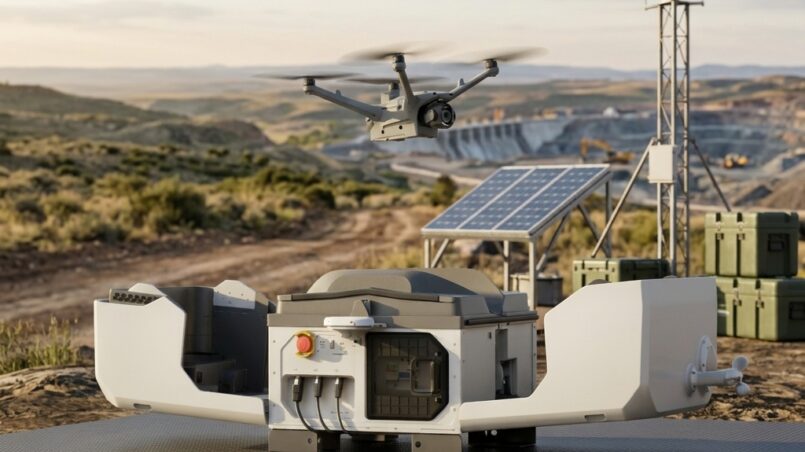
The DJI Dock 4 targets one of the biggest limitations of drone-in-a-box operations: battery downtime. DJI’s first dock with fully automatic battery swapping can replace a depleted battery in under 25 seconds, helping an aircraft return to the air much faster than a conventional charging-based system. Combined with the DJI Matrice 5TD, DJI FlightHub 2, and compatible safety accessories, the Dock 4 forms an automated drone deployment system designed for emergency response, infrastructure inspection, and remote monitoring.
The concept is straightforward. Instead of waiting for a battery to recharge after a flight, the dock replaces it with a ready-to-use pack. The aircraft can then launch again with minimal interruption. However, fast battery swapping is only one part of the system. Compatibility, operating conditions, software workflows, regulatory requirements, and total deployment costs also matter.
This DJI Dock 4 review examines its battery-swapping system, specifications, Matrice 5TD aircraft, FlightHub 2 integration, accessories, advantages, and limitations.
Why the DJI Dock 4 Matters
Traditional drone docks generally recharge the aircraft while it remains inside the dock. That approach can leave the drone unavailable for approximately 30 minutes after a flight, depending on the battery and charging conditions. For emergency operations, this waiting period can affect how quickly a team receives aerial information.
The DJI Dock 4 changes the process with a robotic battery replacement mechanism. After the aircraft lands, the dock removes the depleted battery and installs a charged one. DJI lists a battery swap time of under 25 seconds and an operational turnaround time of under 45 seconds, measured from landing to the next takeoff in a controlled test environment.
This is an important difference between the DJI Dock 4 and a conventional charging dock. The system is designed to reduce the interval between missions rather than increase the aircraft’s flight time.
For police departments, fire services, utilities, and industrial operators, rapid redeployment may be more valuable than simply extending a single flight. A drone can return to the dock, receive a battery replacement, and become available for another task.
The Dock 4 also builds on the DJI Dock 3 platform. Organizations already using Dock 3 may find the battery-swapping upgrade particularly relevant, although compatibility and installation requirements should be confirmed before planning a site upgrade.
DJI Dock 4 Specs at a Glance
The following specifications summarize the supplied product information.
| Spec | DJI Dock 4 |
|---|---|
| Battery swap | Under 25 seconds, fully automatic |
| Turnaround | Under 45 seconds, landing to takeoff |
| Battery bays | 4 compartments holding up to 3 batteries |
| Charging | About 27 minutes, 15% to 95% at 25°C |
| Size, closed | 639 x 640 x 836 mm |
| Size, open | 1750 x 640 x 550 mm |
| Weight | 66 kg, without aircraft and batteries |
| Protection | IP56 |
| Temperature | -40°C to 50°C, with battery preheating and air conditioning |
| Wind landing limit | 12 m/s |
| Max altitude | 5,000 m |
| System radius | Up to 10 km |
| Link | O4 Enterprise Enhanced via the O4 Ground Station |
| Warranty | DJI Care Enterprise Plus, a new tier |
| Price | Not published |
DJI’s official Dock 4 specifications explain that the swap and turnaround measurements come from controlled testing. Actual performance can vary depending on operating conditions. The four battery compartments also do not mean that the dock can hold four batteries for normal operation: the swapping mechanism requires a maximum of three batteries across the compartments.
How DJI Dock 4 Battery Swapping Works
The DJI Dock 4 battery swapping system is designed to manage battery replacement automatically. After the aircraft returns and lands, the dock can replace the battery according to configured operational conditions.
The supplied source information describes several situations in which a battery swap may occur: after landing, before an operation begins, and one hour before a scheduled mission. Battery replacement is also subject to battery-level conditions. The dock swaps when the difference between the weakest and strongest battery exceeds 10%, or when the best battery is above 90%, according to the source.
These rules are intended to keep the aircraft ready for upcoming missions without requiring an operator to manually replace each battery.
Battery Capacity and Dock Backup Power
Each battery is reported to have a capacity of 260 Wh and can provide approximately 4.5 hours of dock backup power, according to DroneXL. If mains power fails, the dock may still perform battery swapping and launch operations while at least two batteries remain.
Standby mode keeps batteries at 95%, helping maintain readiness. However, backup power should not be treated as a complete substitute for normal power. The dock’s functions during a power outage may be limited, and operators should review DJI’s official documentation for the exact behavior under their installation conditions.
The Battery-Bay Trade-Off
One of the practical limitations of the DJI Dock 4 is its battery capacity. Although it has four battery compartments, one is reserved for the swapping mechanism. This means only three batteries can be stored at a time.
The dock also uses the same 400 × 400 mm mounting pattern as Dock 3, according to the supplied article. This may simplify certain site upgrades, but installation compatibility should still be checked against the official installation manual.
For additional details, DJI provides a Dock 4 FAQ covering battery replacement methods and compatibility.
DJI Matrice 5TD: The Aircraft Inside the Dock
The DJI Matrice 5TD is the aircraft designed to work with the DJI Dock 4. The supplied article states that it cannot be flown with a remote controller and is built specifically for dock-based operations.
Its sensor combination is central to the system. Rather than requiring separate aircraft for visual inspection, thermal imaging, and distance measurement, the Matrice 5TD brings several capabilities together in one platform.
DJI Matrice 5TD Specifications
The DJI Matrice 5TD is the only drone that fits this dock. It cannot fly with a remote controller at all. DJI built it as a dock-first aircraft, and that focus shows.
| Spec | DJI Matrice 5TD |
|---|---|
| Flight time | Up to 59 minutes (DJI’s practical figure is about 48) |
| Speed | 21 m/s in FlyTo mode, 15 m/s otherwise |
| Range | Up to 53 km flight distance |
| Wind resistance | 12 m/s, with Wind-Exceed Descend-and-Return |
| Protection | IP55, -40°C to 50°C |
| Wide camera | 50 MP, 1/0.98″ CMOS, 23.5 mm equivalent, f/1.8 |
| Medium tele | 50 MP, 70 mm equivalent, 3x optical |
| Tele camera | 50 MP, 252 mm equivalent, up to 176x hybrid zoom, RYYB night colour |
| Thermal | 1280 x 1024 native, 2560 x 2048 super resolution, 32x zoom |
| Laser rangefinder | Up to 3,000 m |
| Obstacle sensing | mmWave radar, rotating LiDAR, 3D infrared and vision sensors |
| AI | On-board recognition of 17 target types |
| Payload | 450 g across up to 3 mounts |
| Link backup | Two 4G modules |
DJI’s own tables disagree on weight. One lists 3.05 kg at takeoff. Another lists 2,050 g. DroneXL reports 2,600 g empty and 3,050 g at takeoff.
Imaging, Thermal Detection, and Laser Ranging
The Matrice 5TD combines wide-angle imaging, medium telephoto, telephoto, thermal imaging, and laser ranging. This setup allows a single flight to capture different types of information.
The visible-light cameras can help operators identify objects and inspect details from a distance. Thermal imaging can support nighttime observation and help detect heat signatures. The laser rangefinder provides distance information that may be useful for positioning and inspection tasks.
The supplied article reports drone-to-cloud video latency of up to 160 ms, which DJI says is about 32% lower than the previous generation. Actual latency depends on network and operating conditions.
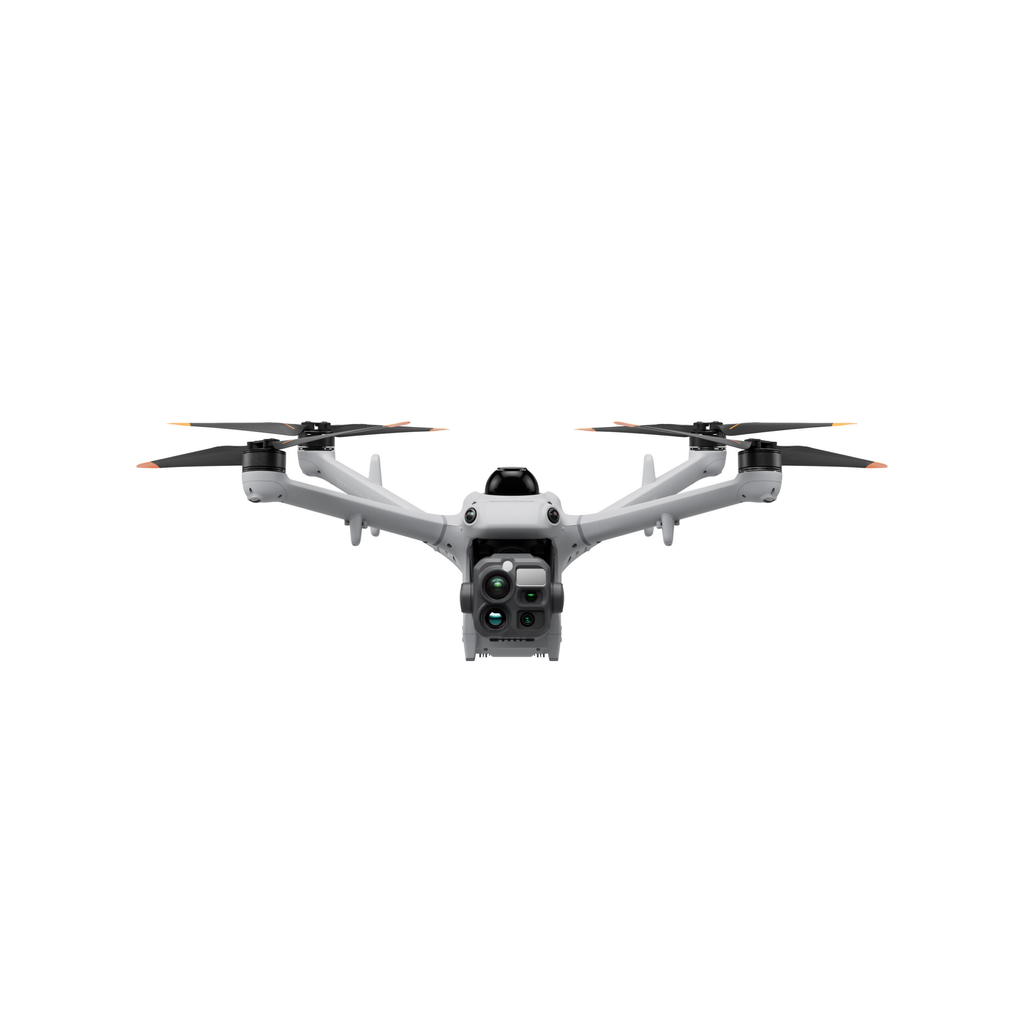
The aircraft’s sensor combination is a key reason the DJI Dock 4 is positioned for emergency response and industrial applications. For other camera-focused technology, readers can also explore the DJI Osmo 360 II vs Insta360 X6 comparison.
Obstacle Sensing and Its Limitations
The Matrice 5TD uses radar and LiDAR to detect obstacles, including thin hazards such as power lines. These systems can be valuable in complex environments where visual sensing alone may be insufficient.
However, the supplied article notes a limitation: activating the spotlight switches off the visual sensors, leaving radar and LiDAR active, according to DroneXL. This is an important operational detail for teams planning night missions.
Operators should review the aircraft’s sensing limitations and conduct appropriate site assessments rather than assuming that every obstacle will be detected in every lighting or flight condition.
Accessories: Spotlight, Speaker, and AP1 Parachute
The Matrice 5TD supports accessories across up to three mounting points, with a combined payload capacity of 450 g.
DJI’s AL2D spotlight is reported to provide 11 lux at 100 m. The AS2D speaker can reach 120 dB at 1 m and supports push-to-talk functionality. A built-in warning light is also included.
These accessories can help expand the aircraft’s use in security patrols, emergency communication, and nighttime operations. Payload selection should still account for the total weight and the mission requirements.
AP1 Parachute and Regulatory Considerations
The parachute system is another important part of the supplied article. Heliguy reports that the AP1 parachute ships pre-installed on UK and EU production units and has been validated against ASTM F3322 through more than 45 deployment tests.
The source also describes an independent flight termination system that operates separately from the flight controller and requires at least one 4G SIM.
With the parachute fitted, Heliguy reports that the Matrice 5TD meets EU C5/C6 and UK5/UK6 requirements. DJI’s launch messaging also mentions STS-01 and STS-02 operations, but the supplied article says this wording could not be confirmed on DJI’s own pages. The source further notes that DJI’s website menu lists an “AP100” parachute, so buyers should confirm the exact accessory model with their dealer.
Regulatory approval and operational permission can vary by country and mission. Organizations should confirm requirements with the relevant aviation authority before deployment.
DJI FlightHub 2: Managing the Drone Response System
DJI FlightHub 2 acts as the software layer connecting the dock, aircraft, operators, and mission data. It supports dock management, mission planning, live flight monitoring, and post-flight review.
For drone-first-response programs, FlightHub 2 can also support automated dispatch workflows. DJI says third-party alerts, including emergency calls, can trigger a workflow. According to the supplied article, an operator must confirm the alert before the drone launches, and the operator does not need to be physically on site.
The article notes that this confirmation process could not be verified on DJI’s public pages, so organizations should request a demonstration before relying on it in a live emergency workflow.
FlightHub 2 Features
The supplied article lists these software capabilities:
- Virtual Cockpit with text or image search for objects
- SMS, email, and platform notifications
- Triggered actions such as snapshots, recording, tracking, and hovering
- Analyzer Pro for change detection and target coordinates
- FH Copilot for AI-assisted route building and reports
- FH Sync, OpenAPI 2.0 with more than 200 endpoints, EventAPI, MQTT Bridge, and single sign-on
- On-premises clustering for teams with more than 20 device licenses
These features may be useful for organizations that need to manage multiple docks, review mission data, or integrate drone operations with existing systems. For a wider look at AI workflows and creative software, see our DaVinci Resolve AI MCP coverage.
How DJI Commercial Products Work Together
Consider a hypothetical emergency response scenario involving a reported break-in. A third-party system sends an alert to DJI FlightHub 2. An operator reviews and confirms the alert, and the Dock 4 opens to launch the Matrice 5TD.
The aircraft can fly toward the scene at up to 21 m/s in FlyTo mode while streaming live video. Radar and LiDAR support obstacle sensing, while the thermal camera can help identify people or heat signatures in low-light conditions.
After the mission, the aircraft returns to the dock. The battery-swapping mechanism replaces the depleted pack, allowing the drone to prepare for another flight without waiting for a conventional recharge.
This workflow illustrates the system’s intended value. The dock reduces downtime, the aircraft supplies imaging and sensing capabilities, FlightHub 2 manages the operational workflow, and compatible safety accessories support specific regulatory or mission requirements.
The DJI Dock 4 does not increase the Matrice 5TD’s maximum flight time. Instead, it aims to keep the aircraft available for more missions over a longer operational period..
DJI Dock 4 Price and Availability
The DJI Dock 4 price has not been published in the supplied article. DJI sells the system through authorized enterprise dealers, so interested organizations must request a quote.
The total cost may include the dock, Matrice 5TD aircraft, O4 Ground Station, and an applicable Care plan. Buyers should confirm what is included in a dealer’s proposal and whether installation, support, accessories, or software requirements are priced separately.
Availability is also a consideration. The supplied article reports that DroneXL found DJI’s radio specifications listing Canada, the EU, China, and Japan, but not the United States. It also notes concerns related to the FCC Covered List and new DJI model authorizations.
Because regulatory status can change, US buyers should verify current FCC requirements and product authorization status before planning a deployment. Availability and supported frequencies may differ by region.
For official product details, see the DJI Dock 4 product page and the DJI Dock 4 download center.
DJI Dock 4 Strengths and Weaknesses
Strengths
- Fully automatic battery swapping in under 25 seconds
- Operational turnaround time under 45 seconds in controlled testing
- IP56 protection rating for the dock
- Operating temperature range from -40°C to 50°C
- Wide, telephoto, thermal, and laser-ranging capabilities in one aircraft
- Radar and LiDAR obstacle sensing
- Parachute option reported to support C5/C6 and UK5/UK6 requirements
- Extensive FlightHub 2 integration
Weaknesses
- No published price
- Regional availability and authorization may limit access
- O4 Ground Station is required
- Compatible only with the Matrice 5TD, according to the supplied article
- Maximum of three batteries stored despite four compartments
- 21 m/s speed applies only in FlyTo mode
- Conflicting aircraft weight figures in DJI’s tables, as reported by the source
- Some FlightHub 2 dispatch workflow details require further confirmation
DJI Dock 4 Price and Availability
The DJI Dock 4 price has not been published. DJI sells the system through authorized enterprise dealers, so you must request a quote. Expect the dock, aircraft, O4 Ground Station and a Care plan to add up.
Availability is the bigger question. DroneXL notes that DJI’s radio specs list Canada, the EU, China and Japan, but not the US. The FCC added foreign-made drones to its Covered List in December 2025, and no new DJI model has been approved since. US buyers should not count on this dock.
Who Should Buy the DJI Dock 4?
The DJI Dock 4 is most relevant to organizations that need rapid, repeatable drone deployment. Police and fire departments are obvious potential users, particularly for drone-first-response programs where aerial information can help ground crews assess a scene.
Utilities, ports, industrial facilities, and large sites may also benefit from automated patrols and inspection workflows. In these settings, a dock-based aircraft can support recurring missions without requiring a pilot to be physically present at the dock for every launch.
Smaller teams operating one or two sites should compare the system’s costs with their mission frequency. If flights are infrequent or the aircraft can remain unavailable while charging, a previous dock such as Dock 3 may be more economical.
Organizations in the United States should also check regulatory and authorization conditions before making purchasing plans. Availability should not be assumed solely from the product’s global announcement.
Final Verdict: A Serious Step Forward for Drone Response
The DJI Dock 4 addresses a real operational problem. Its fully automatic battery swapping system can reduce the interval between flights from a conventional recharge period to a turnaround measured in seconds. The Matrice 5TD adds a capable sensor combination, while FlightHub 2 connects the aircraft to mission planning, monitoring, and workflow management.
The system’s strongest value is not longer flight time. It is improved aircraft availability. That distinction matters for emergency response, remote inspection, and continuous monitoring programs where rapid redeployment can be a priority.
There are still important questions around price, real-world uptime, battery-swap reliability, regional availability, and the exact operator-confirmation workflow. Organizations should validate these details with DJI or an authorized dealer and test the system under their own operating conditions.
Overall, the DJI Dock 4 is a meaningful step forward for automated drone deployment. Its 25-second battery swap is a major feature, but the complete value depends on how well the dock, aircraft, software, and operational requirements work together.
DJI Dock 4 FAQ
What is the DJI Dock 4?
The DJI Dock 4 is a drone-in-a-box system with fully automatic battery swapping. It is designed to work with the DJI Matrice 5TD and supports remote, automated drone deployment.
How fast is the DJI Dock 4 battery swap?
DJI lists a battery swap time of under 25 seconds. The operational turnaround from landing to the next takeoff is listed as under 45 seconds in controlled testing.
How much does the DJI Dock 4 cost?
DJI has not published a price in the supplied article. The system is sold through authorized DJI Enterprise dealers, so buyers need to request a quote.
Which drone works with the DJI Dock 4?
The supplied article identifies the DJI Matrice 5TD as the compatible aircraft and says it is designed for dock-first operation.
What does DJI FlightHub 2 do with the Dock 4?
FlightHub 2 manages docks, plans missions, monitors live flights, and reviews data. DJI also describes alert-triggered workflows for dispatch, although the operator-confirmation details should be verified in a demonstration.
Does the DJI Dock 4 work in the United States?
The supplied article raises concerns about US authorization and availability. Buyers should check current FCC requirements and confirm availability with an authorized dealer before purchasing.
Does the Matrice 5TD meet EU C5/C6 and UK5/UK6 requirements?
Heliguy reports that the aircraft meets these requirements with the AP1 parachute installed. Buyers should confirm the exact accessory model and applicable local rules before operating.
DJI Dock 4 Links and Reviews
For additional information, consult DJI’s official product resources and the cited industry coverage:
- DJI Dock 4 official product page
- DJI Dock 4 specifications
- DJI Dock 4 FAQ
- DJI Dock 4 download center
- Heliguy: DJI Dock 4 and Matrice 5TD product information
- DroneXL: DJI Dock 4 and Matrice 5TD launch coverage
- KrASIA: DJI Dock 4 battery-swapping coverage
Explore more technology coverage on CircuitVerdict, including our camera coverage and phone coverage.
Check our other tech coverages here.