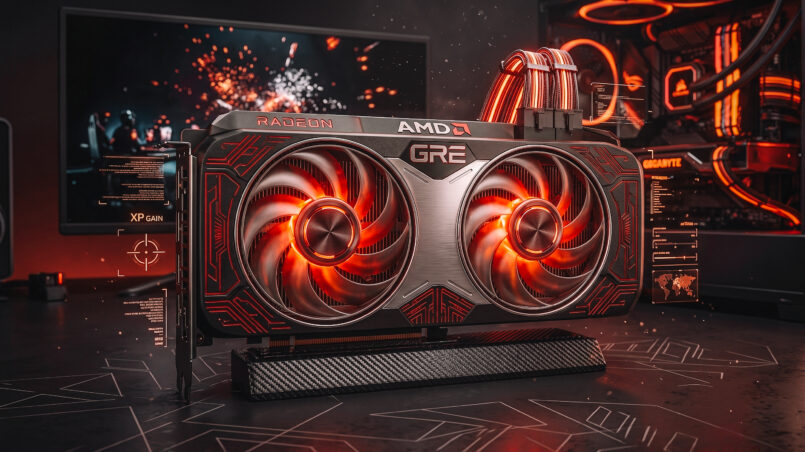
The RX 9070 GRE is AMD’s attempt to bring RDNA 4 graphics to gamers who want strong 1440p performance without paying for a higher-tier GPU. Built around the Navi 48 graphics processor, the Radeon RX 9070 GRE combines modern ray-tracing hardware, AI accelerators, and AMD’s FSR 4 upscaling technology in a more restricted configuration than the standard RX 9070.
Originally launched in China in May 2025, the card expanded into the global market in June 2026 with a stated $549 MSRP. Its positioning sounds appealing: a graphics card designed for high-quality 1440p gaming, modern rendering features, and a price below the standard RX 9070.
The problem is that the reductions go beyond compute performance. The card has 12GB of GDDR6 memory, a 192-bit memory bus, and less Infinity Cache than its higher-tier sibling. Those compromises matter when games use demanding textures, ray tracing, or 4K resolutions.
This RX 9070 GRE review examines the specifications, gaming performance, memory limitations, competition, and price. The central question is whether the savings make
What Is Actually Inside
The AMD Radeon RX 9070 GRE uses the Navi 48 GPU, the same graphics processor family found in the RX 9070 and RX 9070 XT. The difference is how much of that silicon is enabled and how the memory subsystem is configured.
The GPU contains 48 compute units out of a possible 64, giving it 3,072 stream processors, 48 third-generation ray-tracing accelerators, and 96 second-generation AI accelerators. Its listed boost clock reaches up to 2.79GHz.
The specifications are summarized below.
RDNA 4 Features You Are Actually Getting
The RX 9070 GRE retains important features from AMD’s RDNA 4 architecture. These include updated ray-tracing hardware, second-generation AI accelerators, modern display connectivity, and a media engine designed to support current video formats.
Ray tracing and FSR 4
Ray tracing simulates how light interacts with surfaces, reflections, and shadows. It can improve visual realism, but the calculations are demanding. AMD’s third-generation ray-tracing accelerators are designed to improve performance compared with RDNA 3, although the gains vary by game and rendering workload.
The card also supports AMD’s FSR 4 technology, which uses machine-learning-based upscaling on supported hardware and games. Upscaling renders a game at a lower internal resolution and reconstructs a higher-resolution image, potentially improving frame rates while retaining visual detail.
The result depends on the game, quality mode, and implementation. FSR 4 should not be treated as a guarantee that every demanding game will run smoothly at 4K with maximum ray tracing enabled.
Learn more about AMD FidelityFX Super Resolution for supported features and compatible games.
Media engine and connectivity
The RX 9070 GRE supports AV1 encoding and decoding, alongside modern display connectivity including DisplayPort 2.1a and HDMI 2.1b on the stated specification. These capabilities are useful for gamers who also record gameplay, stream video, or edit content.
AV1 can provide efficient video compression, while modern display interfaces support high refresh rates and high resolutions when paired with compatible monitors and cables.
For creators who game on the same PC, the media engine adds flexibility beyond rendering frame rates. However, software support, recording settings, and the rest of the system still affect the final
AMD’s own Benchmark Claims at 1440p Ultra
AMD’s supplied benchmark claims compare the RX 9070 GRE with competing graphics cards at 1440p using demanding game settings. The reported test configuration includes a Ryzen 7 9800X3D processor, 32GB of DDR5-6000 memory, and AMD’s 26.5.2 driver.
The games listed include Arc Raiders, Call of Duty: Black Ops 7, Forza Horizon 5, Grand Theft Auto V Enhanced, Ghost of Tsushima, Horizon Forbidden West, Marvel’s Spider-Man 2, and The Last of Us Part II.
AMD claims a 22% performance lead over the RTX 5060 Ti 16GB and a 26% performance-per-dollar advantage at the respective MSRPs. Those numbers represent AMD’s selected test results and should not be interpreted as a universal advantage in every game.
Independent testing provides a more nuanced picture. Tom’s Hardware found that the card can deliver strong raster performance at 1080p and 1440p, but also noted that 12GB of VRAM can limit performance in demanding ray-traced games. TechSpot’s review similarly found that the GRE’s performance varies significantly by title and that its price makes the positioning difficult.
Read the full independent analyses from Tom’s Hardware and TechSpot before making a purchase decision.
The practical conclusion is that the RX 9070 GRE can be a capable 1440p card, but its performance depends on the game and settings. Rasterization, ray tracing, and high-resolution texture workloads can produce different results, so buyers should prioritize benchmarks that reflect their own gaming library.
Where it Stands Against the Competition
The RX 9070 GRE faces two important comparisons: AMD’s standard RX 9070 and NVIDIA’s GeForce RTX 5070 or RTX 5060 Ti 16GB. Each offers a different balance of performance, memory capacity, and software features.
| Graphics card | VRAM | Memory bus | Positioning |
|---|---|---|---|
| Radeon RX 9070 GRE | 12GB GDDR6 | 192-bit | Lower-cost RDNA 4 option |
| Radeon RX 9070 | 16GB GDDR6 | 256-bit | Higher performance and more VRAM |
| GeForce RTX 5070 | 12GB GDDR7 | 192-bit | NVIDIA’s competing performance tier |
| GeForce RTX 5060 Ti 16GB | 16GB GDDR7 | 128-bit | More VRAM and NVIDIA software features |
Specifications alone do not determine which card is faster. Architecture, memory speed, drivers, game engines, and upscaling support all affect performance.
The standard RX 9070 has a clear hardware advantage in memory capacity and bandwidth. Independent reviews also show that it can deliver a meaningful performance uplift over the GRE in several games. If the street-price difference is small, paying more for the standard model can be the smarter long-term choice.
The RTX 5070 offers NVIDIA’s software ecosystem and DLSS features. The RTX 5060 Ti 16GB has more VRAM than the GRE, which can be helpful in some memory-heavy games, although its narrower bus and lower overall performance tier create different trade-offs.
For PC gamers evaluating how software can affect the experience beyond raw hardware specifications, our article on Denuvo and PC gaming compatibility offers additional context.
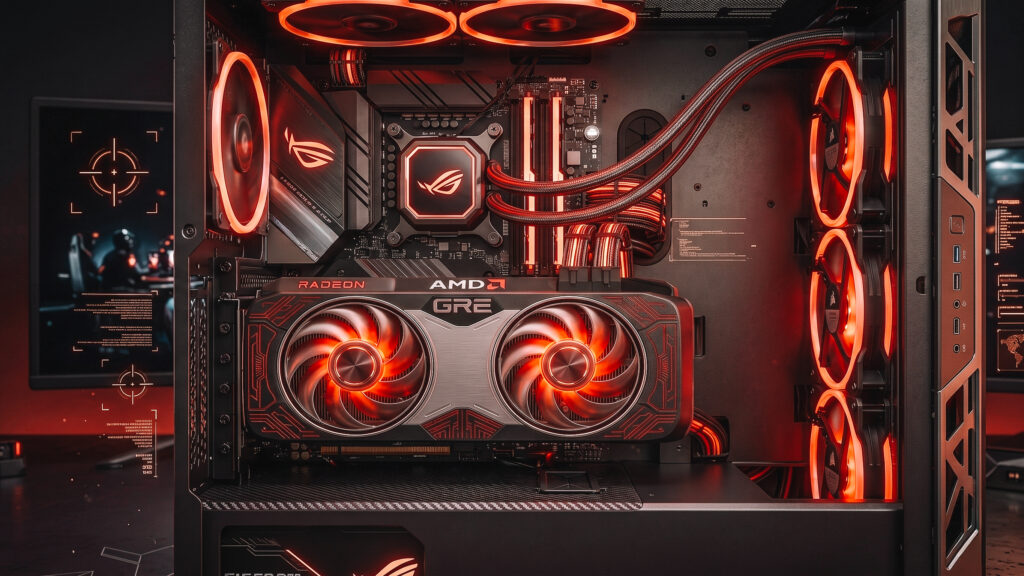
The media engine deserves a mention too. AV1 encode and decode support comes standard. DisplayPort 2.1a and HDMI 2.1b outputs handle high-refresh 1440p with ease and drive 4K without issue. Encoding quality has improved significantly over previous Radeon generations. For content creators who also game, this card covers both needs without compromise.
Where it Stands Against the Competition
The RX 9070 GRE faces two important comparisons: AMD’s standard RX 9070 and NVIDIA’s GeForce RTX 5070 or RTX 5060 Ti 16GB. Each offers a different balance of performance, memory capacity, and software features.
| Graphics card | VRAM | Memory bus | Positioning |
|---|---|---|---|
| Radeon RX 9070 GRE | 12GB GDDR6 | 192-bit | Lower-cost RDNA 4 option |
| Radeon RX 9070 | 16GB GDDR6 | 256-bit | Higher performance and more VRAM |
| GeForce RTX 5070 | 12GB GDDR7 | 192-bit | NVIDIA’s competing performance tier |
| GeForce RTX 5060 Ti 16GB | 16GB GDDR7 | 128-bit | More VRAM and NVIDIA software features |
Specifications alone do not determine which card is faster. Architecture, memory speed, drivers, game engines, and upscaling support all affect performance.
The standard RX 9070 has a clear hardware advantage in memory capacity and bandwidth. Independent reviews also show that it can deliver a meaningful performance uplift over the GRE in several games. If the street-price difference is small, paying more for the standard model can be the smarter long-term choice.
The RTX 5070 offers NVIDIA’s software ecosystem and DLSS features. The RTX 5060 Ti 16GB has more VRAM than the GRE, which can be helpful in some memory-heavy games, although its narrower bus and lower overall performance tier create different trade-offs.
For PC gamers evaluating how software can affect the experience beyond raw hardware specifications, our article on Denuvo and PC gaming compatibility offers additional context.
The 12GB problem at 4K and beyond
Twelve gigabytes of VRAM is not automatically inadequate for modern gaming. At 1440p, it can be sufficient for many titles, particularly when players use sensible texture settings and avoid unnecessarily demanding combinations of ray tracing and high-resolution assets.
The problem emerges when games exceed the available graphics memory. When a workload requires more VRAM than the GPU can comfortably accommodate, performance can become less consistent, with reduced frame rates or stuttering in some circumstances.
The RX 9070 GRE’s narrower memory bus and reduced cache can add further pressure in demanding scenarios. At 4K, the GPU must process more pixels than at 1440p, and ray tracing can increase the workload further. That does not mean every 4K game will perform poorly, but it makes the GRE less attractive for buyers who want maximum settings across the board.
If you plan to use a 4K display regularly, the standard RX 9070 or a higher-tier GPU is generally the safer direction, depending on current pricing. For a 1440p system, the GRE makes more sense.
Long-term ownership also deserves consideration. Games and creative applications evolve, and memory demands can increase over time. Buyers planning to keep a GPU for four or more years should weigh the value of extra VRAM against the upfront savings.
The Naming Problem Nobody Asked For
The RX 9070 GRE name suggests a close relationship with the standard RX 9070, but the reduced compute configuration and memory subsystem make it a more distinct product than the name might imply.
TechSpot argued that the card’s positioning is awkward, particularly at its $550-class launch price. That criticism comes down to the difference between the product’s performance tier and its price. The GRE is capable, but it does not always deliver enough savings to make its compromises easy to accept.
A lower price would make the trade-offs more attractive. At $499, for example, the card would have a clearer position for gamers who prioritize 1440p raster performance. At $549, its value depends heavily on whether competing GPUs are selling near their suggested prices.
Street prices change with stock, retailer promotions, and regional availability. That means the best buying decision should be based on the actual prices available on the day you shop, not MSRP alone.
The RX 9070 GRE is a good card priced in a way that makes it harder to recommend than it deserves to be.
Who Should Actually Buy This
The RX 9070 GRE makes the most sense for gamers upgrading from a graphics card that is several generations old and targeting 1440p gaming. It brings RDNA 4 features, modern video encoding, ray-tracing improvements, and FSR 4 support to a card that can deliver strong performance in many conventional rendering workloads.
It is less compelling for someone upgrading from a recent mid-range GPU. The real-world improvement may not justify the expense, particularly if the current card already delivers acceptable frame rates at the intended resolution.
Buyers focused on 4K gaming, heavy ray tracing, or long-term VRAM headroom should look closely at the standard RX 9070 and competing models with 16GB of memory. NVIDIA’s DLSS ecosystem may also matter to users whose favorite games support it well.
Partner cards are available from brands including Sapphire, PowerColor, ASRock, XFX, Gigabyte, Acer, and ASUS. Cooling design, card dimensions, noise levels, warranty coverage, and local pricing can vary between models, so compare the exact version before buying.
For additional hardware context, see our AMD Ryzen 7 5800X3D review and our NVIDIA RTX Spark analysis.
The buying advice is straightforward: choose the GRE when its actual price is meaningfully lower than the standard RX 9070 and your main goal is 1440p gaming. If the price gap is small, the extra VRAM and wider memory interface of the standard RX 9070 are usually more persuasive.
Frequently Asked Questions
Is the RX 9070 GRE good for 1440p gaming?
Yes. The RX 9070 GRE is primarily aimed at 1440p gaming and can deliver strong performance in many rasterized games. Results vary by title, graphics settings, and whether ray tracing is enabled.
What are the RX 9070 GRE specs?
The card uses RDNA 4 and the Navi 48 GPU, with 48 compute units, 3,072 stream processors, 12GB of GDDR6 memory, a 192-bit bus, and 432GB/s of memory bandwidth.
How much does the RX 9070 GRE cost?
The supplied launch price is $549. Actual retail prices can vary by country, model, stock, and promotions, so compare current listings before purchasing.
RX 9070 GRE vs. RX 9070: Which is better?
The standard RX 9070 has 16GB of VRAM, a wider 256-bit memory bus, and more compute units. It is generally the stronger option, especially if the price difference is modest.
Is the RX 9070 GRE suitable for 4K gaming?
It can run some games at 4K, but it is less suitable for consistently demanding 4K settings with ray tracing. The 12GB memory capacity and lower bandwidth make the standard RX 9070 a more comfortable choice for many 4K workloads.
RX 9070 GRE vs. RTX 5070: Which should you buy?
Neither card wins in every game. The GRE can perform well in rasterized workloads, while the RTX 5070 offers NVIDIA’s DLSS features and software ecosystem. Compare independent benchmarks for the games you play and the prices available locally.
Conclusion
The RX 9070 GRE is a capable RDNA 4 graphics card with strong 1440p potential, updated ray-tracing hardware, and support for AMD’s modern upscaling technology. Its weaknesses are equally clear: 12GB of VRAM, a narrower memory bus, and pricing that can bring it uncomfortably close to the standard RX 9070.
For someone upgrading from older hardware and focused on 1440p gaming, the GRE can make sense at the right price. For buyers planning to play demanding 4K games, use ray tracing extensively, or keep their GPU for many years, the standard RX 9070’s additional memory and bandwidth offer a more convincing proposition.
Ultimately, this is a card whose value depends on the market. Buy the RX 9070 GRE when the savings are substantial enough to justify its compromises. If the price difference is small, spending more on the standard RX 9070 is usually the better long-term decision.