There are CPUs, and then there are CPUs that become legends. The AMD Ryzen 7 5800X3D belongs firmly in the second category. When it launched in April 2022, its 3D V-Cache technology helped it deliver impressive gaming performance on a platform that was already several years old.
Now, at Computex 2026, AMD has brought it back in a special 10th Anniversary Edition to celebrate a decade of the AM4 socket. The processor returns with eight Zen 3 cores, 16 threads, 96MB of L3 cache, and a stated launch price of $349. For gamers who already own compatible AM4 hardware, this could provide a practical upgrade without requiring a complete system rebuild.
The important question is whether the Ryzen 7 5800X3D still makes sense in 2026—and whether existing AM4 owners should upgrade or move to a newer platform.
Why AMD Is Bringing Back the Ryzen 7 5800X3D
To understand the relaunch, consider the cost of upgrading a gaming PC. Moving to a newer platform can mean buying a processor, motherboard, and memory together. For someone with a capable B550 or X570 motherboard and DDR4 memory already installed, that additional expense may not be necessary.
AMD’s anniversary edition gives existing AM4 owners another option. Instead of replacing the entire platform, compatible systems may be able to receive a CPU upgrade after checking motherboard support and installing the required BIOS update.
The original Ryzen 7 5800X3D also became difficult to find at reasonable prices after its supply declined. The anniversary edition’s stated $349 launch price offers a clearer reference point for buyers who want this particular processor.
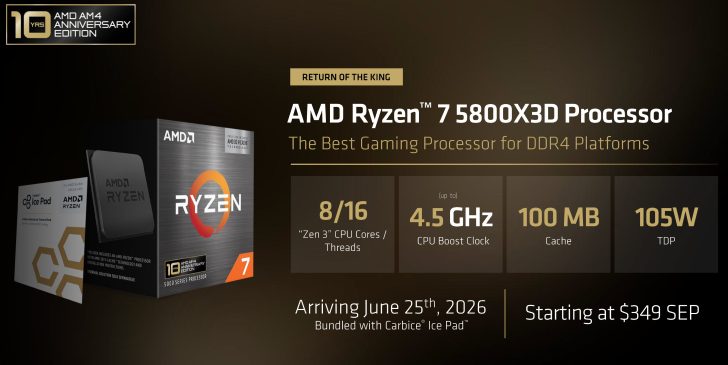
According to AMD’s official Computex 2026 announcement, the company is celebrating ten years of AM4 with the special edition and continuing to provide options for gamers who want to extend the life of existing systems.
| Architecture | Zen 3 with 3D V-Cache |
| Cores/Threads | 8C / 16T |
| Base/Boost Clock | 3.4 GHz / 4.5 GHz |
| Total Cache | 96MB (32MB Zen 3 + 64MB 3D V-Cache) |
| TDP | 105W |
| Platform | AM4 |
| Overclocking | N/A (V-Cache Limitations) |
| Launch Price/Date | $349, June 25, 2026 |
The rebooted AMD Ryzen 7 5800X3D lands on June 25th at $349 USD, paired with a Carbice Ice thermal pad. It will not include a hardware cooler in the box. For the record, the 5800X3D cost $449 when it released in 2022, making this relaunch a meaningful price reduction for a chip that still punches well above its weight.
Ryzen 7 5800X3D Price: Is $349 Good Value?
The anniversary edition has a stated launch price of $349, compared with the original processor’s $449 launch price in 2022.
For an existing AM4 owner, the value calculation can be straightforward. If the motherboard, DDR4 memory, storage, and graphics card are still suitable, upgrading the processor may cost considerably less than rebuilding around a newer platform.
For someone building a new gaming PC, the decision is less obvious. A newer platform may offer a longer upgrade path and access to newer processors, so buyers should compare the complete system cost rather than considering CPU prices alone.
Local prices and availability can differ from the suggested US launch price. Check current retailer listings before purchasing, especially if the anniversary edition is in limited supply.
For independent reporting on the relaunch and its pricing, read TechSpot’s coverage of AMD’s Computex 2026 announcements.
The Carbice Ice Pad: What Comes in the Box?
One notable feature of the anniversary package is the Carbice Ice Pad, a carbon-nanotube-based thermal interface material. The original article describes it as a long-life alternative to conventional thermal paste, intended to maintain contact and thermal conductivity over time.
The inclusion is relevant because the processor’s cooling setup still matters. A thermal interface material transfers heat from the CPU to the cooler, but it cannot replace an adequately sized cooler or good case airflow.
The anniversary bundle described in the original article does not include a conventional hardware cooler. Buyers should therefore budget for a compatible cooler and confirm that its mounting hardware and installation requirements suit their system.
The pad should also be installed according to the manufacturer’s instructions. Actual temperatures depend on the cooler, mounting pressure, case airflow, ambient temperature, and workload.
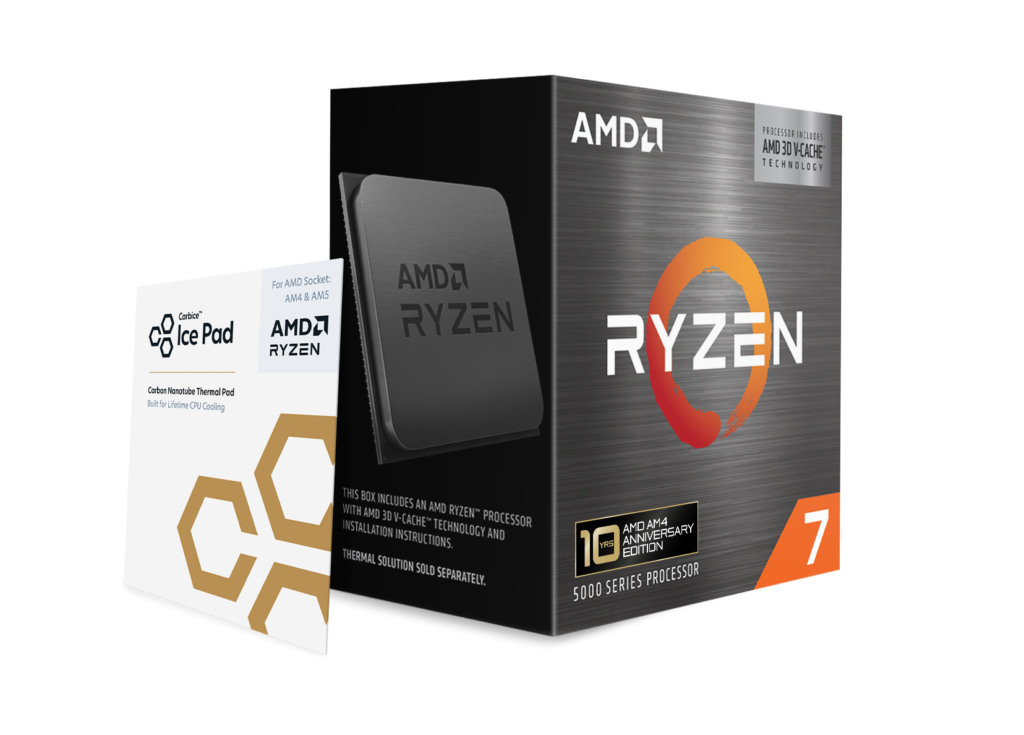
The choice to bundle it here is particularly thoughtful given the AMD Ryzen 7 5800X3D’s thermal design. The 3D V-Cache layer sits directly above the compute die, creating a localised heat transfer path that conventional thermal paste does not always handle evenly over long periods of use. The Carbice Ice Pad is designed to maintain consistent contact and thermal conductivity over time, even without the kind of reapplication schedule that paste requires. For a chip being handed to users who may not revisit their cooler for years, it is a genuinely practical inclusion and not just a marketing flourish. Noctua will also sell the Ice Pad separately for other AM4 CPUs, which tells you AMD and Carbice see this as the beginning of a broader availability story, not just a limited bundle.
“A four-year-old chip, relaunched for a decade-old socket, bundled with thermal technology borrowed from server infrastructure. AMD is not playing it safe. It is reading the room.”
Is the Ryzen 7 5800X3D Still Good for Gaming in 2026?
The short answer is yes, depending on the system and games involved. The Ryzen 7 5800X3D’s 3D V-Cache gives it an advantage in some gaming workloads because frequently accessed data can remain closer to the processor cores.
Games vary in how much they benefit from cache. Some are sensitive to CPU performance and memory access, while others depend more heavily on the graphics card. As a result, no single benchmark can describe performance in every game.
At 1080p, the CPU can have a significant influence on frame rates, especially with a powerful GPU and a high-refresh-rate monitor. At 1440p, the balance between CPU and GPU depends on the title and graphics settings. At 4K, the graphics card often becomes the primary limit, although CPU-heavy games can still expose a bottleneck.
The original article compares the processor with the Intel Core i9-14900K in gaming workloads. Such comparisons should be treated as game- and test-specific rather than a universal result. Benchmark settings, memory configuration, GPU choice, and the games tested can all change the outcome.
For many existing AM4 gamers, the more useful question is whether the processor will improve their current setup enough to justify its price.
Choosing the Right Components
Pairing the Ryzen 7 5800X3D with appropriate components helps the system deliver consistent performance. Memory configuration, motherboard firmware, cooling, and graphics hardware all matter.
Memory and motherboard
A dual-channel DDR4 memory configuration is important for a gaming PC. DDR4-3600 CL14 or CL16 is suggested in the original article, although stable settings depend on the particular memory kit, motherboard, and processor.
Before installation, check the motherboard manufacturer’s CPU support list and BIOS requirements. B550 and X570 boards are relevant options, but support should be confirmed for the exact model and revision.
Graphics card
The original article identifies RTX 4070-class and Radeon RX 7800 XT-class graphics cards as potential pairings. These are starting points, not strict limits: the right GPU depends on resolution, target frame rate, graphics settings, and the games being played.
For more graphics hardware coverage, see our AMD Radeon RX 9070 GRE article.
CPU cooling
The processor has a default TDP of 105W. A compatible cooler with good contact pressure and adequate heat dissipation is important, particularly during sustained workloads.
The included Carbice Ice Pad does not remove the need for proper cooling. Keep case airflow in mind and monitor temperatures if you experience unexpected performance drops.
Windows and background settings
The original article recommends reviewing Windows security settings that may affect some gaming workloads. However, disabling Core Isolation or Memory Integrity reduces security protections. These features should not be disabled automatically for a small potential performance gain. Test your system first and make security decisions based on your actual requirements.
Ryzen 7 5800X3D vs Moving to AM5
The main decision is whether to extend an existing AM4 system or move to AM5.
The 5800X3D is appealing if you already have compatible hardware and want a gaming-focused CPU upgrade without buying a new motherboard and memory kit. Reusing existing components can reduce both the cost and the amount of work involved.
AM5 is worth considering for a new build or for users who want access to newer processor generations. AMD has announced continued AM5 platform support through 2029, which may be relevant to buyers who value future upgrade options.
The right choice depends on your budget, the total platform cost, and how long you plan to keep the system. A gaming PC used primarily for 1080p or 1440p play has different priorities from a workstation used for rendering, encoding, or other heavily threaded tasks.
| Component | Recommended Pick | Why it Matters |
| Memory | DDR4-3600 CL14 or CL16, dual channel | Up to 12% higher avg FPS and 20% better 1% lows vs. DDR4-2666. Dual channel is non-negotiable. |
| Motherboard | B550 or X570 with robust VRMs | Update BIOS to latest AGESA before installing. Enable DOCP/EXPO for memory profiles. |
| GPU | RTX 4070 / RX 7800 XT or below | The sweet spot for this CPU at 1440p. Beyond this, AM5 becomes the better pairing. |
| Cooler | Noctua NH-U12A or Arctic Liquid Freezer II 240 | V-Cache creates an asymmetric hot spot. A quality cooler with good contact pressure prevents thermal throttling. |
| Windows Setting | Disable Core Isolation / Memory Integrity | Known to add 1 to 3ms of latency in certain games. A small but free performance gain. |
For more PC hardware coverage, explore our Circuit Verdict technology articles.
Who Should Buy the Ryzen 7 5800X3D?
The anniversary edition is most compelling for people who already own an AM4 gaming PC and want to improve CPU performance without replacing the entire platform.
It is worth considering if you:
- Already own a compatible AM4 motherboard.
- Have suitable DDR4 memory installed.
- Want to upgrade from an older Ryzen processor.
- Prioritize gaming performance in CPU-sensitive titles.
- Prefer a processor upgrade over a full system rebuild.
It may be less attractive if you are building a new high-end PC from scratch or need the newest platform features. In those situations, compare the full cost and capabilities of a newer system before deciding.
Frequently Asked Questions
What is the Ryzen 7 5800X3D price in 2026?
The anniversary edition has a stated launch price of $349. Retail prices and availability may vary by region and seller.
How many cores does the AMD Ryzen 7 5800X3D have?
It has eight cores and 16 threads, with a base clock of 3.4GHz and a maximum boost clock of up to 4.5GHz.
Is the Ryzen 7 5800X3D compatible with AM4 motherboards?
It uses the AM4 socket. Check your exact motherboard model and BIOS version before upgrading; compatibility should not be assumed for every AM4 board.
Is the Ryzen 7 5800X3D good for gaming?
It can deliver strong gaming performance, especially in titles that benefit from its 96MB of L3 cache. Results depend on the game, graphics card, resolution, and settings.
Does the anniversary edition include a CPU cooler?
The original article states that a conventional hardware cooler is not included. Plan for a separate compatible cooler and follow the thermal pad’s installation instructions.
Should I choose AM4 or AM5 for a new PC?
AM4 may be more economical if you already own compatible components. For a new build, compare the complete system cost and future upgrade options of AM5 before making a decision.
Final Verdict: AM4 Still Has a Place
The AMD Ryzen 7 5800X3D remains relevant because its 3D V-Cache design can benefit gaming workloads, while its AM4 compatibility allows existing PC owners to extend the life of their systems.
The anniversary edition’s stated $349 launch price gives gamers another option if they already own a compatible motherboard and DDR4 memory. For those users, a CPU upgrade may be more practical than a complete platform migration.
For new PC builders, the decision is more complicated. A newer platform may provide a better long-term upgrade path, depending on budget and requirements.
Ultimately, the AMD Ryzen 7 5800X3D is not the universal best CPU for every system. Its strongest case is as a gaming-focused upgrade for existing AM4 owners who want to get more life from hardware they already have.
Check out our other product coverages here.