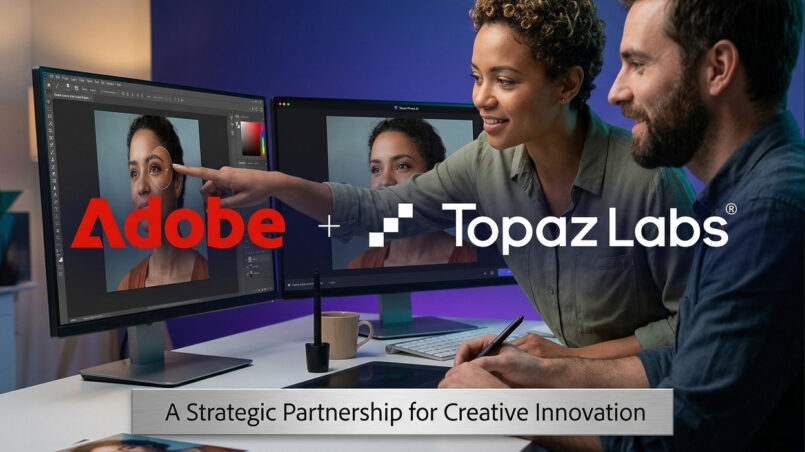
Adobe’s acquisition of Topaz Labs marks a significant change for the image and video enhancement software market. Announced on June 25, 2026, the deal was completed on September 23, 2026, bringing Topaz Labs’ AI enhancement technology into Adobe’s creative ecosystem. For photographers, video editors, filmmakers, and digital creators, the key question is what this means for the tools they already use.
Topaz Labs built its reputation on software that improves existing images and footage through AI-powered upscaling, denoising, sharpening, stabilization, and restoration. Its products include Topaz Photo, Topaz Video, and Topaz Gigapixel. Adobe plans to integrate more of this technology into its own creative products while continuing to make Topaz products available as standalone offerings.
That distinction matters. Many users chose Topaz because it worked as a dedicated enhancement tool outside a single editing ecosystem. The acquisition offers potential benefits through closer integration, but creators will also be watching pricing, software support, local processing, and compatibility with non-Adobe workflows.
What Adobe Is Actually Buying
Topaz Labs is more than a collection of image-enhancement plugins. Its software focuses on improving visual material that already exists, whether that means increasing image resolution, reducing noise in low-light photographs, restoring old footage, or improving video clarity.
Its products serve different needs. Topaz Photo focuses on photo enhancement, Topaz Video handles video enhancement and restoration, and Topaz Gigapixel specializes in enlarging images. The company has also developed products including Astra and Bloom. Together, these tools cover several demanding tasks in photography, post-production, and archival restoration.
Adobe announced that Topaz Labs had millions of customers, including 20 of the world’s 50 largest companies. The company also brought Emmy Award-winning technology for video enhancement and restoration into the transaction. These assets offer Adobe an established set of specialized tools rather than requiring it to develop every capability from scratch.
Neurostream is a key part of the deal
One of the most important technologies involved is Neurostream, Topaz Labs’ proprietary technology for running complex AI models locally on consumer devices. Local processing can reduce reliance on cloud services and help professionals work with sensitive material without necessarily uploading source files to a remote server.
This is especially relevant to filmmakers, studios, and production teams handling unreleased projects or footage protected by client agreements. However, local processing depends on the model, device, and workflow being used. Some tools may also offer cloud-based options, so users should check the processing method for each feature rather than assume every operation runs entirely on their computer.
Adobe says Topaz technology will help expand its image and video enhancement capabilities across Adobe Firefly, Firefly Services, and Creative Cloud applications. The acquisition therefore combines specialist enhancement models with Adobe’s existing software distribution and creative workflow tools.
For the official deal announcement, see Adobe’s acquisition statement. Adobe also published an update when the acquisition was completed, outlining its plans for Topaz products and technology.
What the acquisition includes
- Image enhancement: Tools for upscaling, sharpening, and reducing image noise.
- Video enhancement: Capabilities for stabilization, frame interpolation, noise removal, and footage restoration.
- Neurostream technology: Infrastructure designed to run complex AI models on local consumer hardware.
- Existing customers: A large user base across individual creators and enterprise customers.
- Creative Cloud integration: Plans to bring more Topaz capabilities into Adobe’s creative software ecosystem.
The financial terms were not disclosed in the original public announcement. Adobe’s later regulatory filing reported a transaction value of approximately $340 million, primarily in cash, subject to customary purchase-price adjustments. See the Adobe SEC filing for the company’s reported transaction details.
Why Adobe Needed This
Adobe has been expanding its AI capabilities across image editing, video production, and creative workflows. Generative AI attracts attention, but professional creators also need tools that improve material they have already photographed or recorded. Sharpening soft footage, reducing noise, restoring archives, and increasing resolution are practical tasks with immediate value in production.
This is where Topaz fits. Generative AI creates or transforms content, while enhancement AI focuses on analyzing and improving existing visual material. The two approaches can work together, but they solve different problems.
For example, a filmmaker may want to upscale older footage without changing the scene’s content. A photographer may need to reduce noise in a high-ISO image while preserving texture. A broadcaster may need to restore archival recordings for modern screens. These are the types of workflows where specialized enhancement models can be useful.
Adobe already had some Topaz technology in its ecosystem before the acquisition. The companies had established a product relationship that included access to Topaz models in Adobe tools. The acquisition takes that relationship further by giving Adobe ownership of the company and its technology.
The strategic opportunity is straightforward: Adobe can combine Topaz’s specialized enhancement capabilities with products such as Photoshop, Lightroom, Premiere Pro, and Firefly. If the integration is effective, creators could complete more of their work without moving between separate applications.
That does not automatically mean Adobe’s existing tools were inadequate or that every Topaz feature will become available in every Adobe product. Integration plans and product availability can vary. Users should evaluate the specific features they need rather than assume the acquisition will immediately change every workflow.
For more technology coverage, explore Circuit Verdict’s latest articles and news section.
The Part That Makes Existing Topaz Users Nervous
Adobe stated that Topaz Labs would remain a standalone brand and that its apps and models would continue to be available as standalone products. The company also said customers could expect continued support. Those commitments are important, particularly for people who purchased or built professional workflows around Topaz software.
However, a promise of continued availability does not answer every long-term question. Users still need clarity on future pricing, licensing, hardware support, software updates, and compatibility with third-party editing applications. Product roadmaps can evolve after an acquisition, even when the brand and standalone apps remain.
Will non-Adobe workflows still work?
This is a central concern for professionals who use Topaz alongside applications such as DaVinci Resolve, Final Cut Pro, or Avid. Their workflows may depend on exporting footage to Topaz for enhancement and then returning it to the main editing application.
Adobe has a strong incentive to make Topaz technology useful across its own ecosystem. Whether the same level of attention will be given to every third-party workflow is a separate question. The acquisition itself does not establish that compatibility will disappear, and users should not assume that it will.
For now, professionals should test their existing projects, keep track of software compatibility requirements, and avoid changing a reliable workflow solely because the ownership has changed. Where a project depends on a particular Topaz feature, it is sensible to document the version, settings, and export process.
Local processing and privacy
Neurostream’s ability to run AI models locally is an important part of Topaz’s value proposition. Local processing can be attractive when handling confidential footage, client photographs, or unreleased creative work.
After the acquisition, users should continue to check the privacy and processing details for individual features. A feature that runs locally may have different requirements from a cloud-based option. The presence of local AI technology does not mean every Adobe or Topaz operation is automatically offline.
For businesses with strict confidentiality requirements, the right questions include whether source files leave the device, which processing options are available, and what data is retained. Those answers should come from the applicable product documentation and organizational settings.
What the Alternatives Look Like Now
The Adobe Topaz Labs acquisition does not leave creators without alternatives. Several other tools specialize in image noise reduction, RAW processing, and upscaling. None needs to replace every Topaz feature to be useful; the best choice depends on the job.
For photographers
DxO offers photo-processing software with noise-reduction and RAW-development tools. It may be worth testing for photographers who prioritize RAW processing and image quality.
ON1 provides photo-editing software and AI-assisted noise-reduction tools. It can be a useful option for creators who want image enhancement within a broader photography workflow.
These tools are not identical to Topaz Photo, and results can vary depending on the camera, image, settings, and desired output. Before switching, compare the same RAW files or difficult images across the applications you are considering.
For image upscaling
Upscayl is a free, open-source image upscaler that may suit users looking for a no-cost alternative. It is worth testing on the kinds of photographs, graphics, or illustrations you actually process.
Other web-based and desktop upscalers may also be suitable, but they can differ in privacy, cost, processing limits, and how faithfully they preserve original details. AI upscaling can invent or alter texture, so inspect outputs carefully when accuracy matters.
For video professionals
Video workflows are harder to compare because enhancement may involve more than resolution. A professional might need noise reduction, stabilization, frame interpolation, restoration, and consistent results across a sequence.
Before replacing Topaz Video, test alternatives using representative footage. Include fast motion, low-light scenes, fine textures, and clips with compression artifacts. Check processing speed, GPU requirements, output quality, and whether the workflow integrates with your editing software.
The practical lesson is to maintain a shortlist rather than make a rushed switch. If Topaz continues to meet your requirements, there may be no immediate reason to leave it. If a future change affects your workflow, documented tests will make it easier to choose a replacement.
The Bigger Picture
The acquisition reflects a wider trend in creative software: independent tools with established professional audiences can become strategic assets for larger platforms. This can give a smaller company’s technology broader distribution, more development resources, and closer integration with widely used applications.
There is another side to the trend. When an independent tool becomes part of a large ecosystem, users may worry about competition, product priorities, pricing, and platform dependence. Those concerns are understandable, but the outcome depends on the decisions made after the deal closes.
Adobe’s completed acquisition gives it access to Topaz’s enhancement models and Neurostream technology. For users already working in Creative Cloud, tighter integration could reduce friction and save time. For users who prefer independent applications, the important question is whether standalone products remain useful, compatible, and appropriately priced.
The acquisition should therefore be judged by its practical results rather than by the announcement alone. Software updates, licensing terms, third-party compatibility, and real-world image and video quality will determine how much value creators receive.
Frequently Asked Questions
Has Adobe completed the Topaz Labs acquisition?
Yes. Adobe announced the acquisition in June 2026 and confirmed completion on September 23, 2026.
Will Topaz Labs products remain available as standalone apps?
Adobe has said that Topaz Labs will remain a standalone brand and that its apps and models will continue to be available as standalone products. Users should check official product announcements for future changes to licensing and availability.
What is Neurostream?
Neurostream is Topaz Labs’ technology for running complex AI models on local consumer devices. It is designed to make advanced image and video enhancement more practical without relying exclusively on cloud processing.
Will Topaz Video AI still work with DaVinci Resolve?
The acquisition announcement does not state that support for DaVinci Resolve will end. Users should check current compatibility information and test their own workflows after software updates.
What are the main alternatives to Topaz Labs?
Depending on the task, alternatives include DxO and ON1 for photography and noise reduction, and Upscayl for free, open-source image upscaling. Video users should test alternatives against their own footage and editing requirements.
Should Topaz users switch to another tool now?
Not necessarily. If your current software works reliably, there is no need to switch solely because of the acquisition. Keep backups, monitor official product updates, and test alternatives before making a change that affects client work.
The Real Question for Creators
The Adobe Topaz Labs acquisition gives Adobe specialist AI enhancement technology, established products, and a large customer base. It could make image and video enhancement more accessible across Adobe’s creative applications while helping Topaz technology reach more users.
For existing customers, the most important issues are continuity, pricing, local processing, and compatibility with non-Adobe workflows. Adobe has stated that standalone products will remain available, but creators should continue to follow official updates and evaluate how the products evolve.
Ultimately, the acquisition is neither automatically a win nor automatically a loss for every user. Its real value will depend on whether Adobe improves the tools without undermining the flexibility that made Topaz attractive in the first place.