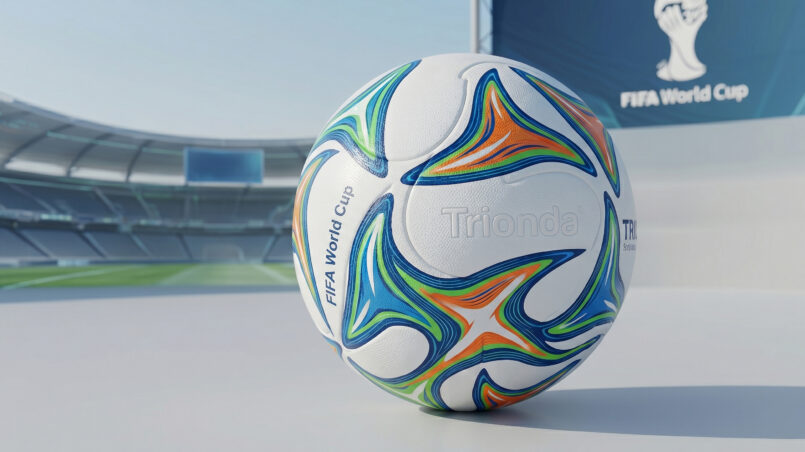
The World Cup 2026 ball is more than the object players kick across the pitch. The Adidas Trionda combines a distinctive four-panel design with connected-ball technology that sends motion data to match officials in real time. For the FIFA World Cup 2026, the official match ball brings together football design, embedded sensors, and video-assisted decision-making in a way that could influence how key moments are reviewed.
The tournament spans Canada, Mexico, and the United States, with 48 teams competing across 16 host cities. Trionda reflects that three-country format through its name, colors, and visual details. Its technology is just as important as its appearance: a 500Hz inertial measurement unit (IMU) sensor records the ball’s movement and helps video officials identify the moment of contact during incidents such as potential offside decisions.
But how does the Trionda ball actually work? Why does it use only four panels, and can a sensor inside a football change the way the game is officiated? Here’s a closer look at the technology behind the FIFA World Cup 2026 official ball..
How the connected-ball sensor works
The Trionda uses an updated version of Adidas Connected Ball Technology. Unlike earlier designs that placed the sensor in a central suspension system, the Trionda’s sensor is housed inside a specially created layer within one of its four panels. Counterweights are distributed across the other panels to help preserve the ball’s balance and flight stability.
The sensor’s information is transmitted to the video operation room in real time. There, officials can combine ball-movement data with player-tracking information and video footage to assess incidents more accurately.
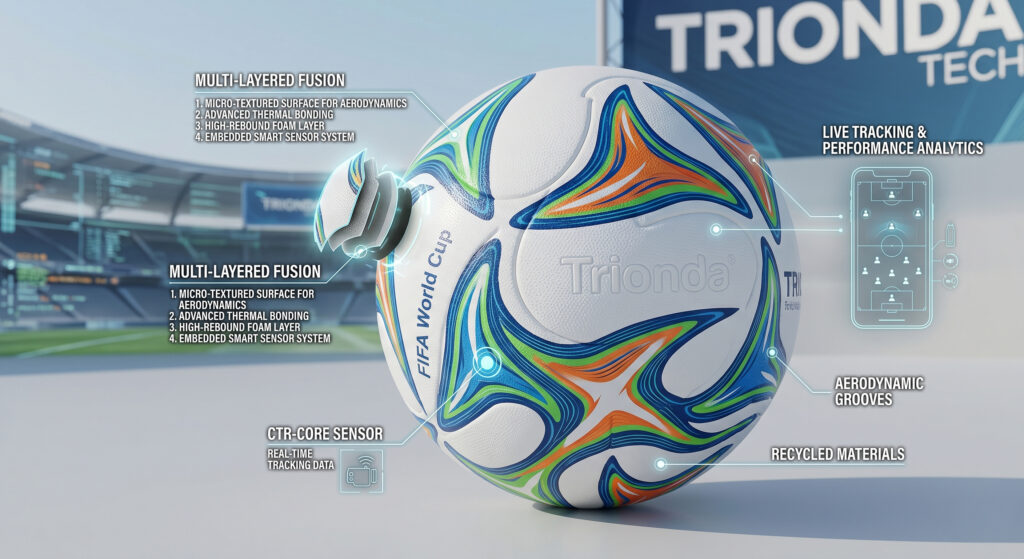
This does not mean the ball independently decides whether an infringement has occurred. Instead, it supplies another layer of evidence that supports the officiating process. The referee and video officials remain responsible for applying the Laws of the Game.
For more details, see FIFA’s official explanation of connected-ball technology and the Adidas announcement introducing Trionda.
Does the sensor affect the ball’s performance?
A reasonable concern is whether electronics inside a football change its weight, balance, or feel. FIFA and Adidas have developed the connected-ball system to provide useful data without compromising the ball’s playing characteristics.
The sensor’s placement and the counterweights are intended to maintain balance as the ball travels through the air. The electronics are integrated into the match ball rather than attached externally, allowing the ball to be used in normal play.
The sensor is also powered by a rechargeable battery. Adidas’ connected-ball technology uses inductive charging, allowing the equipment to be charged without a conventional exposed charging connector. The match-day ball must be prepared and charged as part of the venue’s equipment process.
How the Design Solves an Old Problem
The Trionda stands out because it uses a four-panel construction, a departure from the multi-panel designs familiar from earlier World Cup footballs. Fewer panels can reduce the number of seams, but the shape and surface of a football influence how air moves around it.
That matters because a football does not travel through the air in a perfectly predictable way. Surface texture, seams, spin, speed, and the way a player strikes the ball can all influence its flight. Manufacturers must balance durability, touch, grip, and aerodynamic behavior when designing a match ball.
Adidas addresses this challenge through the geometry of the four panels, deliberately deep seams, and embossed surface details. The seams help create suitable and evenly distributed aerodynamic drag, while the textured surface is designed to improve grip when players strike or dribble the ball, including in wet or humid conditions.
The aim is not simply to make the ball look different. Its construction is intended to provide predictable flight behavior while delivering the practical playing characteristics expected at the highest level of football.
Why fewer panels matter
A four-panel ball offers a different construction approach from designs made with more individual panels. The panel geometry influences how the outer surface is assembled, where seams sit, and how the ball responds to airflow.
However, fewer panels do not automatically make a football more accurate or faster. Performance depends on the complete design, including material, surface texture, seam depth, internal structure, and manufacturing consistency.
For players, the important question is whether the ball behaves consistently during passes, shots, crosses, and long-range kicks. For goalkeepers, predictable flight is particularly important when judging the trajectory of a fast-moving shot.
The Trionda’s design combines aerodynamic considerations with visual identity, showing how sports equipment can integrate engineering and branding into the same product.
Behind the Name
The name Trionda combines “Tri,” meaning three, and “Onda,” meaning waves in Spanish. It refers to the three countries hosting the 2026 FIFA World Cup: Canada, Mexico, and the United States.
The ball’s red, green, and blue design reflects those host nations. Its visual elements include a maple leaf associated with Canada, an eagle representing Mexico, and a star associated with the United States. Gold details reference the FIFA World Cup trophy.
The four panels connect through flowing geometric shapes that create a triangular pattern. This design is intended to represent the relationship between the three host countries while giving the ball a distinctive appearance on the pitch and in broadcast footage.
Trionda was unveiled as the official match ball on October 2, 2025. The launch continued Adidas’ long-running role as the supplier of official FIFA World Cup match balls.
The design is also a reminder that the official ball serves several purposes at once. It must perform consistently during elite competition, withstand demanding match conditions, support the connected-ball system, and provide a recognizable visual identity for the tournament.
For the official announcement and design background, read FIFA’s introduction to the Trionda official match ball.
Why This Matters Beyond One Tournament
The Trionda’s most immediate technological contribution is the information it supplies to match officials. In football, a decision can depend on a fraction of a second: when a pass was played, whether a player was in an offside position at that moment, or whether a particular touch changed the ball’s direction.
Traditional video review relies on footage captured by cameras at a limited number of frame intervals. Connected-ball data provides an additional source of information about the ball’s movement and the moment it was touched.
Supporting semi-automated offside decisions
For offside decisions, timing is critical. Officials need to establish the moment a teammate played or touched the ball and compare that moment with the positions of the attacking player and relevant defenders.
The Trionda’s sensor can help pinpoint the contact moment. When combined with player-tracking data from stadium cameras and video analysis, that information supports FIFA’s semi-automated offside technology.
The technology can help officials reach decisions faster and more consistently, but it does not remove the need for human judgment. The rules still determine whether a player is in an offside position and whether that position constitutes an offence.
Helping review possible handball incidents
Connected-ball technology can also provide useful information when officials investigate possible handball situations. Detecting a touch and understanding how the ball moved can help clarify what happened during a disputed incident.
However, the sensor cannot independently decide whether a handball offence occurred. The context of the contact, the player’s actions, and the relevant rules remain essential to the final decision.
What happens if the sensor fails?
Connected-ball technology is designed to support the existing officiating system, not replace every other method of review. FIFA describes backup procedures that allow traditional VAR methods and camera-based tracking to be used if connected-ball data is unavailable.
That redundancy is important in a major tournament. Match officials need a reliable way to continue reviewing important incidents even if one component of the technology does not work as expected.
The broader lesson is that modern sports technology is most useful when it improves the information available to people making decisions without making the entire process dependent on a single device.
Technology is changing other areas of computing and digital production as well. For another look at how specialized hardware is being designed around demanding workloads, read our coverage of NVIDIA RTX Spark and its AI-focused computing platform.
The same principle applies across these fields: more data is valuable when it helps users make better-informed decisions, rather than simply adding complexity.
Could connected-ball technology become standard?
The Trionda demonstrates how embedded sensors can become part of a sporting product without turning it into an obvious electronic device. The sensor records motion, the data reaches the officiating system, and the information can be used alongside other sources during a review.
Future systems could potentially deliver more detailed data for analysis, coaching, and broadcast presentation. For example, ball movement and player tracking can help create clearer visual explanations of a disputed incident. These are possible applications of connected sports data, not a guarantee that every future ball will include every feature.
The technology also raises practical considerations, including reliability, charging, data integration, and the need to keep equipment consistent across matches. Any wider adoption would need to preserve fair competition and avoid making the game unnecessarily dependent on complicated procedures.
The World Cup provides a prominent setting for testing and demonstrating these technologies under demanding conditions. What becomes standard in the future will depend on performance, cost, reliability, and whether governing bodies find that the benefits justify broader use.
Frequently Asked Questions
What is the World Cup 2026 ball called?
The official FIFA World Cup 2026 match ball is called Adidas Trionda. Its name refers to three waves and celebrates the tournament’s three host nations: Canada, Mexico, and the United States.
Does the Adidas Trionda have a sensor inside it?
Yes. The match-day Trionda includes an inertial measurement unit motion sensor that operates at 500Hz, capturing movement data 500 times per second. The data helps video officials assess ball-contact moments.
How does the Trionda smart ball help VAR?
The sensor supplies information about the ball’s movement and the moment it is touched. Officials can combine this data with player tracking and video footage to support decisions, particularly in potential offside incidents.
Why does the FIFA World Cup 2026 ball have four panels?
The four-panel construction gives Trionda its distinctive design and allows Adidas to incorporate deliberately deep seams and textured surfaces. These features are intended to support aerodynamic stability and grip.
Does the Trionda sensor make the ball heavier or change its flight?
The connected-ball system is designed to preserve the ball’s playing characteristics. Sensor placement and counterweights help maintain balance, although the overall performance depends on the ball’s complete construction.
Can the Trionda ball make referee decisions automatically?
No. It provides data that assists match officials but does not independently decide whether an offside or handball offence has occurred. Officials still apply the Laws of the Game.
Can fans buy the exact connected Trionda match ball?
The connected match-day version is intended for professional play and is not available to consumers in the same form. Consumer versions may resemble the official design but should not be assumed to include the same connected-ball electronics.
Conclusion
The World Cup 2026 ball, Adidas Trionda, demonstrates how football equipment can combine visual design, aerodynamic engineering, and embedded electronics. Its four-panel construction, textured surface, and 500Hz motion sensor make it more than a traditional match ball.
Its biggest contribution may be the information it provides to match officials. By helping identify the precise moment of ball contact, connected-ball technology can support semi-automated offside decisions and provide additional evidence during reviews of disputed incidents.
The technology does not replace referees or guarantee that every decision will be correct. Instead, it adds another source of information to an already complex officiating system.
Trionda’s significance extends beyond the 2026 tournament. It shows how connected equipment can help modern sports become more precise while preserving the game itself. The most successful sports technology is not necessarily the technology fans notice first. It is the technology that helps the game run more fairly, consistently, and confidently.
Check out our other news coverages.