ultra-wide perspectives to its full-frame E-mount lineup.
Sony has finally filled one of the strangest gaps in its E-mount lineup with the FE 8-14mm F3.5 Fisheye G, its first native fisheye zoom for full-frame Alpha cameras. The lens marks a significant return to a category Sony had largely left untouched for two decades. The last Sony-branded fisheye option was the 16mm f/2.8 lens for A-mount, introduced in 2006 as a Minolta design.
For photographers interested in fisheye photography, the new lens offers a more flexible approach than a fixed-focal-length optic. It can capture a complete circular fisheye image at 8mm or produce a diagonal fisheye perspective that fills the frame at 14mm. Autofocus, a constant f/3.5 aperture, and a lightweight body further distinguish it from more basic fisheye alternatives.
The FE 8-14mm F3.5 Fisheye G is designed for creative photography, architecture, landscapes, action sports, and video production. However, its unusual perspective and $1,599.99 price mean it is a specialist lens rather than an everyday wide-angle choice. This Sony fisheye lens review examines its design, optical specifications, creative potential, limitations, and the photographers who may benefit most from it.
Sony’s official FE 8-14mm F3.5 Fisheye G announcement outlines the lens’s circular-to-diagonal coverage and full-frame E-mount compatibility. For readers exploring other camera systems and optics, our lens reviews offer additional comparisons and coverage.
One Lens, Two Perspectives
The defining feature of the FE 8-14mm F3.5 Fisheye G is its unusual zoom range. Rather than behaving like a conventional wide-angle zoom, it provides two distinctly different fisheye perspectives.
At 8mm, the lens creates a circular fisheye image with a 180-degree field of view. The image appears as a circle surrounded by black areas because the projection does not fill the entire rectangular frame. This perspective is useful for dramatic compositions where the circular image itself becomes a central creative element.
At 14mm, the image expands to fill the full-frame sensor as a diagonal fisheye. The lens still captures a 180-degree diagonal field of view, but the resulting composition is more practical for many photographs because the entire frame is occupied.
The focal lengths between 8mm and 14mm are less compelling in practical use. They can produce substantial vignetting without delivering the distinctive circular appearance of 8mm or the full-frame coverage of 14mm. As a result, the lens is best understood as two useful perspectives in one compact body rather than a traditional zoom with equally valuable settings throughout its range.
This design makes the lens especially interesting for photographers who want to experiment with fisheye effects without carrying separate circular and diagonal fisheye lenses. A closer look at DPReview’s coverage of Sony’s fisheye zoom provides further context about the two perspectives.
Optical Design and Image Quality
Sony equips the FE 8-14mm F3.5 Fisheye G with 16 elements in 13 groups. The optical construction includes three aspherical elements, four ED elements, and one ED aspherical element. These components are intended to control optical aberrations while maintaining detail across the image.
Fisheye lenses are designed to produce pronounced distortion, so their image quality should not be judged in exactly the same way as that of a conventional rectilinear wide-angle lens. The curved appearance of lines is part of the intended effect. The more relevant considerations include detail, color fringing, contrast, and how consistently the lens performs across its image area.
The constant f/3.5 maximum aperture is another useful feature. It remains available throughout the zoom range, making exposure adjustments more predictable when switching between the circular and diagonal perspectives. Although f/3.5 is not exceptionally bright compared with some specialized lenses, it provides a consistent aperture for both still photography and video.
The lens also offers a minimum focusing distance of 0.15m and a maximum magnification of 0.22x. This allows photographers to move close to a subject and exaggerate the relationship between foreground and background. For example, a nearby object can appear dramatically large while the surrounding environment remains visible.
For a broader perspective on its performance, see the Sony FE 8-14mm F3.5 Fisheye G review from PetaPixel.
Autofocus and Handling
Autofocus is an important advantage for this fisheye lens. Sony uses two linear motors to drive focusing, providing fast and reliable autofocus performance. This is particularly useful for action sports, moving subjects, and video production, where manual focus can make it harder to maintain consistent subject sharpness.
The lens also features minimal focus breathing, helping reduce distracting changes in the field of view during focus transitions. This can be useful for filmmakers who need to shift focus between subjects within a scene.
Despite its bulbous front element, the lens supports rear drop-in filters. This is a practical engineering solution because conventional front-mounted filters are difficult to use with such an extreme fisheye design. Rear filters can provide creative and exposure-control options without requiring a standard front filter thread.
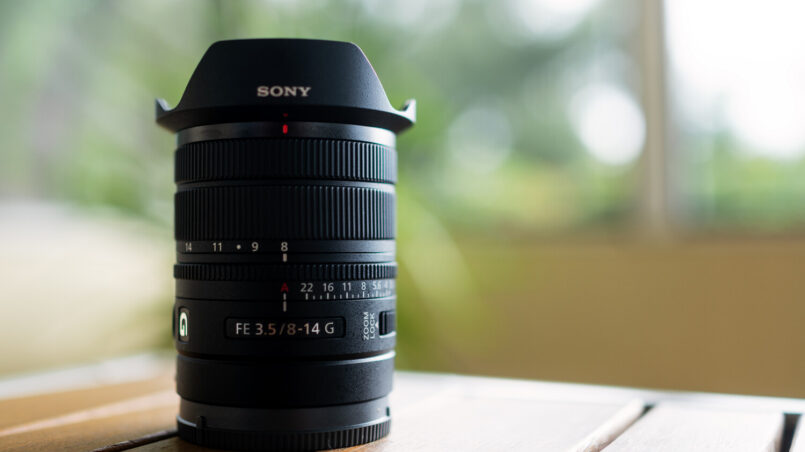
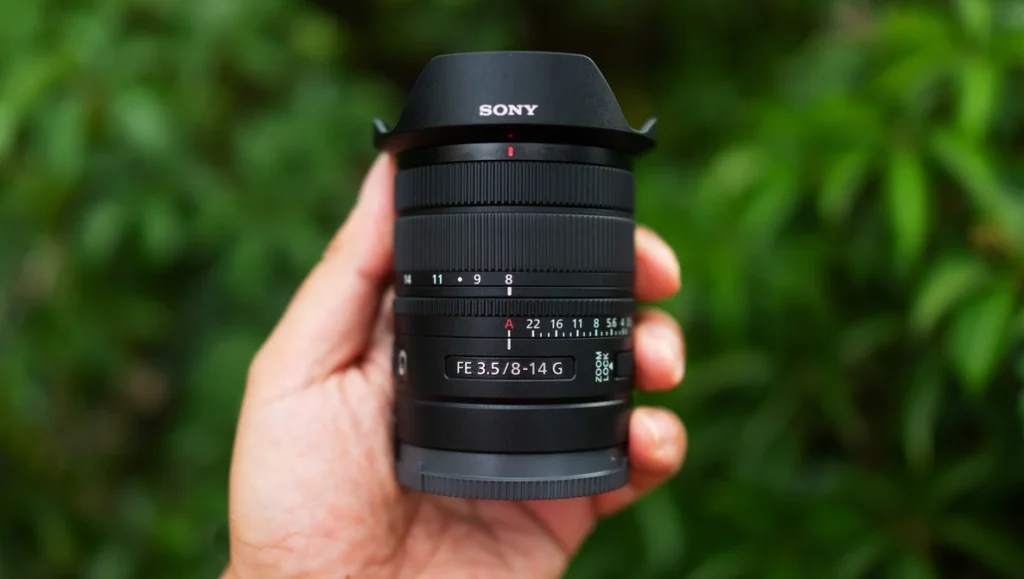
At just 314g, the FE 8-14mm F3.5 Fisheye G is compact and lightweight. Its dimensions are approximately 63.1mm in diameter and 82.8mm in length. That size makes it easier to carry for travel and outdoor photography than many larger specialty lenses.
The lens also features weather resistance and a fluorine coating on the front element. These features can help protect it when shooting in challenging environments, although weather resistance should not be treated as a guarantee of complete protection against water, dust, or other conditions.
Sony FE 8-14mm F3.5 Fisheye G Specifications
| Specification | Details |
|---|---|
| Lens name | Sony FE 8-14mm F3.5 Fisheye G |
| Focal length | 8-14mm |
| Maximum aperture | Constant f/3.5 |
| Angle of view | 180° fisheye coverage |
| Optical design | 16 elements in 13 groups |
| Special elements | 3 aspherical, 4 ED, 1 ED aspherical |
| Minimum focus distance | 0.15m |
| Maximum magnification | 0.22x |
| Autofocus | Two linear motors |
| Weight | 314g |
| Dimensions | Ø63.1 × 82.8mm |
| Filter support | Rear drop-in filter holder |
| Image stabilization | No built-in stabilization |
| Price | $1,599.99 |
| Availability | Pre-orders September 29; shipping October 9, 2026, as stated in the supplied article |
The specifications make the lens a compact option for full-frame Sony E-mount cameras. Readers considering a complete camera setup can also explore our camera coverage and reviews for additional equipment information.
Fisheye Photography: Creative Uses
A fisheye lens is not intended to replace a conventional wide-angle lens. Its value comes from the distinctive perspective and exaggerated distortion it introduces. The FE 8-14mm F3.5 Fisheye G gives Sony users multiple ways to apply that effect.
Architecture and interiors: A fisheye perspective can capture a large room or architectural space in a single composition. Curved lines become part of the visual style, making it useful for creative architectural photography. However, photographers seeking natural-looking straight lines may prefer a rectilinear wide-angle lens.
Action sports: Skateboarding, cycling, and other action sports can benefit from the dramatic perspective of a fisheye. Shooting close to the subject can make the action appear more immersive while retaining a wide view of the surroundings. Autofocus also helps when subjects move quickly.
Landscapes and travel: The lens can include expansive scenery, foreground details, and dramatic skies in one image. At 8mm, the circular composition creates a distinctive visual effect; at 14mm, the diagonal fisheye perspective can be more practical for a full-frame image.
Video and creative projects: The combination of autofocus and minimal focus breathing makes the lens relevant to video creators. It can be used for music videos, immersive action footage, and unusual camera perspectives. Sony also identifies video production and spatial content applications among the lens’s intended uses.
For photographers learning how to use a fisheye lens, the most useful starting point is to experiment with distance and composition. Moving closer to the subject exaggerates the perspective, while changing the focal length alters how the circular or diagonal effect appears. The photographer’s feet, camera accessories, and unwanted background elements can easily enter the frame, so careful framing is important.
The lens’s creative strengths are also discussed in Amateur Photographer’s review, which highlights its circular and diagonal coverage, constant aperture, and compact design.
What Works
- Compact and lightweight design at just 314g
- Fast and reliable autofocus for a fisheye lens
- Two distinct perspectives in one lens
- Constant f/3.5 maximum aperture throughout the zoom range
- Rear drop-in filter support despite the curved front element
- Weather-resistant construction with a fluorine front coating
- Close-focusing capability for dramatic foreground compositions
What Doesn’t
- Mid-zoom focal lengths are less useful due to vignetting
- The $1,599.99 price is high for an occasional-use lens
- Fisheye photography is a specialized style rather than a general-purpose solution
- No built-in image stabilization
- The extreme distortion may not suit photographers who prefer natural-looking wide-angle images
Verdict
Sony’s FE 8-14mm F3.5 Fisheye G is a notable addition to the company’s full-frame E-mount lineup. After a long gap in Sony’s native fisheye options, the lens delivers a compact design, autofocus, a constant f/3.5 aperture, and two genuinely different perspectives.
Its greatest strength is the combination of circular fisheye coverage at 8mm and diagonal fisheye coverage at 14mm. Rather than offering a conventional zoom experience, it gives photographers two distinctive ways to compose creative images. The lightweight 314g body and rear filter support also make it more practical than its unusual optical design might suggest.
However, this is not a lens that every Sony photographer needs. Its specialist nature, pronounced distortion, limited usefulness across the middle of the zoom range, and $1,599.99 price make it a considered purchase. Photographers who mainly shoot portraits, everyday travel, or conventional landscapes may find a standard wide-angle lens more versatile.
For architecture, action sports, immersive travel photography, and creative video, the FE 8-14mm F3.5 Fisheye G offers a compelling native Sony option. It is a strong choice for photographers who specifically want a fisheye lens for Sony E Mount and value autofocus and compact handling.
If you are comparing lenses before making a purchase, explore our lens category and Sony camera comparison coverage to learn more about Sony’s camera and lens ecosystem.
Frequently Asked Questions
1. What is the Sony FE 8-14mm F3.5 Fisheye G?
The Sony FE 8-14mm F3.5 Fisheye G is a full-frame E-mount fisheye zoom lens. It provides circular fisheye coverage at 8mm and diagonal fisheye coverage at 14mm, with a constant f/3.5 maximum aperture.
2. Is the Sony FE 8-14mm F3.5 Fisheye G a full-frame lens?
Yes. It is designed for Sony full-frame Alpha E-mount cameras. Its circular fisheye image at 8mm and diagonal fisheye image at 14mm offer different ways to use the full-frame sensor.
3. What is the price of the Sony FE 8-14mm F3.5 Fisheye G?
The supplied article lists its price at $1,599.99. This is a premium price for a specialist lens, so its value depends on how frequently a photographer uses fisheye perspectives.
4. Is the Sony FE 8-14mm F3.5 Fisheye G good for action photography?
Its wide field of view and autofocus system make it suitable for creative action photography, including skateboarding and other sports. The fisheye perspective can make close action appear more dramatic.
5. Can the Sony FE 8-14mm F3.5 Fisheye G use filters?
Yes. The lens supports rear drop-in filters. This design is useful because its curved front element does not provide a conventional front filter mounting option.
6. Is the Sony FE 8-14mm F3.5 Fisheye G worth buying?
It can be worth buying for photographers who regularly create fisheye images, action-sports footage, or immersive creative compositions. For general photography, a conventional wide-angle lens may be a more versatile investment.
7. How do you use a fisheye lens for creative photography?
Start by experimenting with the distance between the camera and the subject. Close positioning exaggerates perspective, while changing focal length allows you to select circular or diagonal fisheye coverage. Pay attention to the edges of the frame because unwanted objects can easily appear in an extremely wide view.
Check out our other Lens reviews for Sony and other ecosystems to decide which brand is suitable for you.
Featured Image: Fstoppers