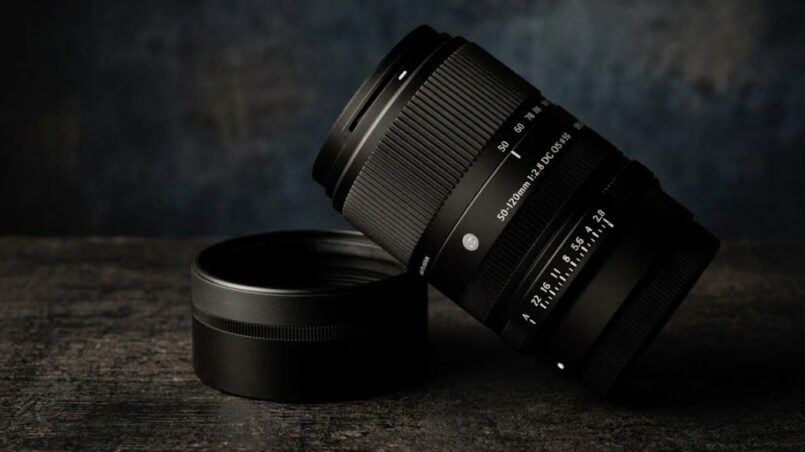
The Sigma 50-120mm f2.8 is the telephoto zoom APS-C photographers have been waiting for. Weighing just 390g on Sony E and Fujifilm X mounts, it combines a constant f/2.8 aperture with a $799 launch price. Alongside Sigma’s existing 10-18mm f/2.8 and 18-50mm f/2.8 zooms, it completes a compact three-lens system covering ultra-wide to telephoto photography.
Sony, Fujifilm, and Canon crop-sensor shooters now have another option for building a fast zoom kit without carrying the weight of a traditional full-frame telephoto. But how does this new Sigma lens fit into a real camera setup? This Sigma 50-120mm f2.8 review explores its specifications, autofocus, stabilization, mount options, price, strengths, and limitations.
What Is the Sigma 50-120mm f2.8?
The Sigma 50-120mm f2.8 is a constant-aperture telephoto zoom designed for APS-C mirrorless cameras. Its full product name is the Sigma 50-120mm F2.8 DC OS | Contemporary. On Sony E and Fujifilm X cameras, its field of view is equivalent to approximately 75-180mm on a full-frame camera. Canon RF APS-C cameras use a 1.6x crop factor, giving a framing equivalent of approximately 80-192mm.
This focal range is especially useful for portraits, weddings, indoor events, and travel photography. It lets photographers frame subjects from a comfortable distance while creating the compressed perspective and background separation associated with telephoto lenses.
Sigma announced the lens on October 8, 2026, with availability beginning October 22, 2026. The company lists Sony E-mount, Fujifilm X-mount, and Canon RF-mount versions. The lens is manufactured in Sigma’s Aizu, Japan, facility.
For official details, see the Sigma 50-120mm F2.8 DC OS | Contemporary product page and Sigma’s launch announcement.
Sigma 50-120mm f2.8 Specs
| Spec | Sigma 50-120mm F2.8 DC OS |
|---|---|
| Mounts | Sony E, Fujifilm X, Canon RF |
| Aperture | Constant f/2.8 to f/22, 11 rounded blades |
| Optics | 18 elements in 13 groups (1 FLD, 3 SLD, 4 aspherical) |
| Stabilization | OS2, 6.5 stops at 50mm and 4.5 stops at 120mm (CIPA) |
| Autofocus | HLA (High-response Linear Actuator) |
| Closest focus | 23cm at 50mm, 55cm at 120mm |
| Max magnification | 1:3 at 50mm, 1:4.7 at 120mm |
| Filter thread | 55mm |
| Weight | 390g (E and X), 410g (RF) |
| Build | Dust and splash resistant, manual aperture ring |
| Price | $799 (US), 799 euros (Europe) |
These Sigma 50-120mm f2.8 specs are based on the manufacturer’s published product information. Sigma notes that the lens is dust- and splash-resistant, not waterproof. Weather resistance should not be treated as protection against heavy rain or immersion.
Autofocus, Stabilization and Optics
Sigma equips this APS-C telephoto zoom lens with an HLA autofocus motor. The High-response Linear Actuator is designed to deliver fast, quiet focusing, making the lens suitable for still photography and video. Sigma also designed the optical system to minimize focus breathing, an advantage when recording video or shifting focus between subjects.
Stabilization is one of the lens’s major features. Its OS2 system is rated for up to 6.5 stops of correction at 50mm and 4.5 stops at 120mm under CIPA testing. This can help photographers capture sharper handheld images in lower-light conditions, especially when shooting stationary subjects.
However, stabilization does not freeze subject movement. A moving person, athlete, or animal may still require a faster shutter speed. The rating is also a standardized measurement rather than a guarantee that every photographer will achieve the same result.
The optical design contains 18 elements in 13 groups, including one FLD element, three SLD elements, and four aspherical elements. These specialized elements are intended to help control optical aberrations and maintain image quality throughout the zoom range.
The lens also uses 11 rounded diaphragm blades. This design can contribute to smoother background rendering, particularly when shooting portraits with the aperture wide open. Actual bokeh depends on subject distance, background placement, focal length, and shooting conditions.
Close focusing adds versatility. At 50mm, the lens focuses as close as 23cm with a maximum magnification ratio of 1:3. At 120mm, the minimum focusing distance is 55cm, with a maximum magnification of 1:4.7. That makes the Sigma 50-120mm lens useful for detail shots, food photography, and product images, although it is not a dedicated macro lens.
For further technical details, consult Sigma’s official specifications.
Build Quality, Weight and the Aperture Ring
Portability is a major selling point of this Sigma telephoto lens. At 390g for Sony E and Fujifilm X versions, it is considerably easier to carry than many traditional constant-aperture telephoto zooms. The Canon RF version weighs 410g.
The compact design makes the lens a practical pairing for smaller APS-C mirrorless cameras. Its 55mm filter thread also allows photographers to use a relatively common filter size for compatible lenses.
Sigma includes dust- and splash-resistant construction, along with a water- and oil-repellent coating on the front element. These features can offer extra protection during outdoor photography, but they do not make the lens waterproof. Users should still avoid prolonged exposure to rain, moisture, or heavy splashing.
Another important addition is the manual aperture ring. Sigma describes this as the first aperture ring on one of its APS-C Contemporary zoom lenses. Fujifilm users who prefer direct exposure controls may find this especially useful, while video creators can benefit from a more tactile way to adjust aperture.
The supplied accessories include a lens pouch, LH585-01 hood, front cap, and rear cap.
The Sigma Holy Trinity at a Glance
The Sigma Holy Trinity APS-C lenses now consist of three constant-f/2.8 zooms:
- Sigma 10-18mm f/2.8 DC DN Contemporary
- Sigma 18-50mm f/2.8 DC DN Contemporary
- Sigma 50-120mm f/2.8 DC OS Contemporary
Together, these lenses cover ultra-wide, standard, and telephoto perspectives. The new 50-120mm zoom completes the range, giving photographers a versatile system for landscapes, everyday photography, portraits, and events.
| Lens | Full-frame equivalent (Sony E/Fuji X) | Weight E | Weight X | Weight RF |
|---|---|---|---|---|
| Sigma 10-18mm f/2.8 | Approx. 15-27mm | 255g | 250g | 270g |
| Sigma 18-50mm f/2.8 | Approx. 27-75mm | 290g | 285g | 300g |
| Sigma 50-120mm f/2.8 | Approx. 75-180mm | 390g | 390g | 410g |
| Full trio | Approx. 15-180mm | 935g | 925g | 980g |
Weights are based on Sigma’s published product specifications. Canon RF APS-C cameras use a 1.6x crop factor, so equivalent framing differs slightly.
The combined weight is the key advantage. A complete set of three constant-f/2.8 zooms weighs less than one kilogram in each listed mount combination. For photographers who want a versatile kit without the bulk of full-frame equipment, this Sigma f2.8 zoom lens trio is appealing.
For context, Fujifilm’s XF 50-140mm f/2.8 alone weighs close to 1kg. The Sigma lineup offers a different approach: three compact lenses that cover a broad range of focal lengths.
Sigma 50 120 for Sony: E-Mount Details
The Sony E-mount version weighs 390g and measures 66.8 x 99.0mm. It is a compact option for APS-C Sony Alpha cameras, including the a6700 and ZV-E10 II.
The Sigma 50-120mm f2.8 for Sony provides a telephoto range that can be useful for portraits, events, and video production. Its constant f/2.8 aperture gives photographers exposure flexibility throughout the zoom range, while optical stabilization can help when shooting handheld.
The lens’s compact size should also make it easier to balance on smaller camera bodies. Sony crop-sensor users looking for a Sigma zoom lens for Sony now have a fast telephoto option that complements the 10-18mm and 18-50mm zooms.
For current mount compatibility and specifications, check the official Sigma E-mount product listing.
Sigma 50 120 for Fuji: X-Mount Details
The Fujifilm X-mount version weighs 390g and measures 66.8 x 99.3mm. Its compact dimensions make it a natural companion for X-series mirrorless cameras.
One of its most notable features for Fujifilm users is the manual aperture ring. Direct aperture control can fit naturally into the handling style of many X-series cameras, particularly for photographers who prefer adjusting exposure using physical controls.
The Sigma 50-120mm f2.8 for Fuji offers a telephoto range suited to portrait sessions, event coverage, and travel. It also complements the Sigma 18-50mm f/2.8, creating a lightweight combination for photographers who frequently work across standard and telephoto focal lengths.
For details on the X-mount model, visit the Sigma product page.
Sigma 50 120 for Canon: RF-Mount Details
The Canon RF version weighs 410g and measures 69.0 x 97.0mm. It is slightly heavier and wider than the Sony E and Fujifilm X versions.
The Sigma 50-120mm f2.8 for Canon RF is designed for APS-C mirrorless cameras, including compatible crop-sensor bodies such as the EOS R7 and R10. Its 1.6x crop factor gives an equivalent framing range of approximately 80-192mm.
This makes the lens a useful option for Canon APS-C photographers who want a constant-f/2.8 telephoto zoom. It can support portrait photography, event coverage, and other situations where a longer focal length and a bright aperture are helpful.
The RF version also completes the Sigma zoom lineup for Canon crop-sensor users. For compatibility and specifications, check Sigma’s official product information.
Price and Availability
Sigma lists the 50-120mm F2.8 DC OS | Contemporary at $799 in the United States and €799 in Europe. The lens was announced on October 8, 2026, and became available from authorized dealers starting October 22, 2026.
The Sigma 50-120mm f2.8 price positions it as a compact alternative to larger telephoto zooms with a constant f/2.8 aperture. The value proposition is not only the price but also its low weight, stabilization, and availability across Sony E, Fujifilm X, and Canon RF mounts.
Sigma also offers a mount conversion service. Photographers who change camera systems may be able to send the lens in for conversion rather than replacing it, subject to Sigma’s service terms and supported mounts.
Check the Sigma US store or Sigma UK product page for regional details and availability.
Where the Lens Falls Short
The Sigma 50-120mm f2.8 is versatile, but it is not the right lens for every photographer.
First, depth of field differs between APS-C and full-frame systems. At equivalent framing, f/2.8 on APS-C provides depth-of-field characteristics roughly comparable to f/4 on full frame. Photographers who prioritize the shallowest possible background blur may prefer a full-frame 70-200mm f/2.8 lens.
Second, the equivalent reach of approximately 180mm on Sony E and Fujifilm X is not especially long for wildlife, distant birds, or field sports. Photographers who regularly need more reach should consider a longer telephoto lens.
Third, Sigma has announced Sony E, Fujifilm X, and Canon RF versions, but no Nikon Z or L-mount versions are listed in the announcement. Nikon Z and Panasonic crop-sensor users will need to consider other compatible options unless Sigma announces additional mounts.
Finally, the lens is not waterproof. Its dust- and splash-resistant construction offers some protection, but photographers working in severe weather should take additional precautions.
For portraits, weddings, events, and travel, the Sigma 50-120mm f2.8 remains a compelling APS-C telephoto zoom lens.
Final Verdict: Sigma Keeps Raising the Bar
The Sigma 50-120mm f2.8 completes a compact APS-C zoom system that many photographers will find practical. Its constant aperture, optical stabilization, HLA autofocus, aperture ring, and lightweight design make it an interesting choice for Sony, Fujifilm, and Canon crop-sensor users.
The biggest benefit is the complete Sigma Holy Trinity: the 10-18mm, 18-50mm, and 50-120mm f/2.8 zooms. Together, they offer broad focal-length coverage without the weight typically associated with a full-frame professional zoom kit.
If portraits and events are your priority, the telephoto may be the first lens to add. The 18-50mm can follow for everyday shooting, while the 10-18mm is a useful choice for landscapes and wide-angle work.
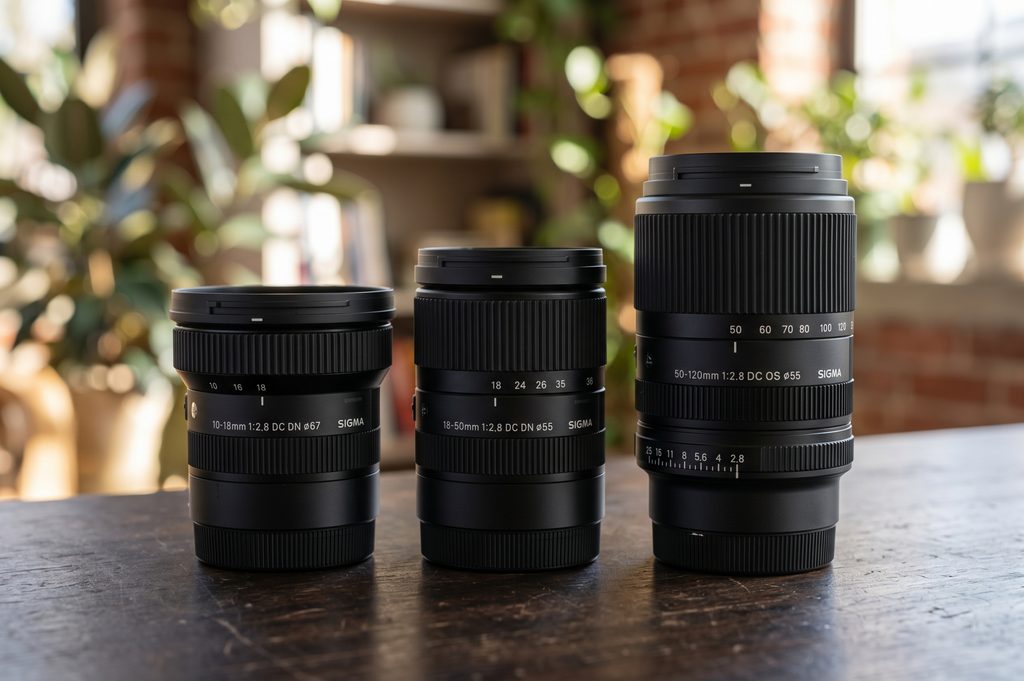
The Sigma 50-120mm f2.8 is not a universal solution for wildlife or photographers who need full-frame-level background separation. But for APS-C users seeking a compact, fast, and flexible telephoto zoom, it deserves serious consideration.
Sigma 50-120mm f2.8 FAQ
Is the Sigma 50-120mm f2.8 compatible with Sony, Fujifilm, and Canon?
Sigma lists Sony E-mount, Fujifilm X-mount, and Canon RF-mount versions. Check the official compatibility information for your exact camera body.
What is the Sigma 50-120mm f2.8 price?
Sigma lists the lens at $799 in the United States and €799 in Europe. Regional prices and dealer availability may vary.
What is the full-frame equivalent focal length?
On Sony E and Fujifilm X APS-C cameras, the equivalent field of view is approximately 75-180mm. On Canon RF APS-C cameras, it is approximately 80-192mm.
Does the Sigma 50-120mm f2.8 have image stabilization?
Yes. The lens uses Sigma’s OS2 stabilization system, rated at 6.5 stops at 50mm and 4.5 stops at 120mm under CIPA testing.
Is the Sigma 50-120mm f2.8 waterproof?
No. Sigma describes the lens as dust- and splash-resistant. It should not be treated as waterproof or exposed to heavy splashing or immersion.
Is the Sigma 50-120mm f2.8 good for portraits?
Its telephoto range and constant f/2.8 aperture make it suitable for portrait photography. Background separation will also depend on focal length, subject distance, and background placement.
Official Sigma Links
- Sigma 50-120mm F2.8 DC OS | Contemporary
- Sigma 50-120mm launch announcement
- Sigma 18-50mm F2.8 DC DN | Contemporary
- Sigma 10-18mm F2.8 DC DN | Contemporary
- Sigma camera compatibility and dealer information
Launch details also covered by Fstoppers.
Check our other lens coverages here.