
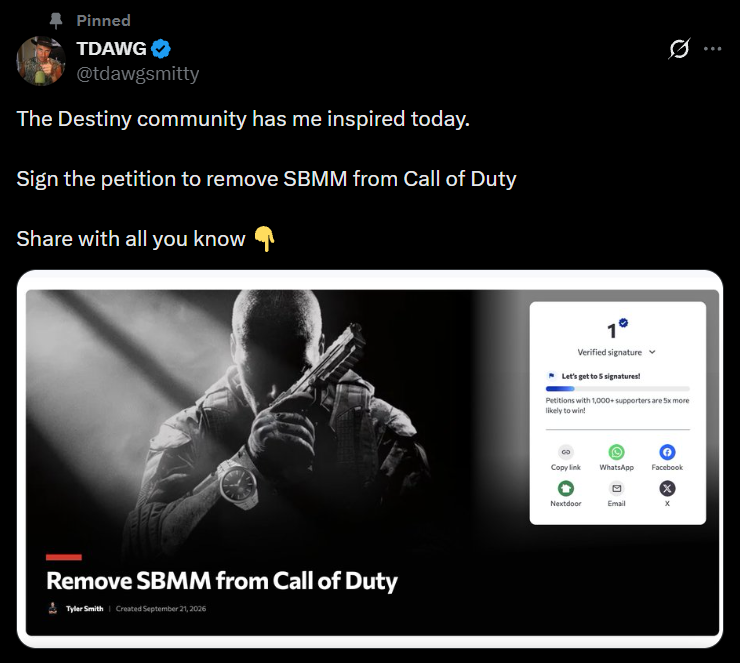
A new Call of Duty skill based matchmaking petition is putting one of the franchise’s longest-running multiplayer debates back in the spotlight. Call of Duty creator Tdawgsmitty is asking Activision to remove SBMM from unranked public lobbies while keeping it in Ranked Play. The campaign draws inspiration from the Destiny community’s recent protest success and arrives as players look ahead to Modern Warfare 4.
The petition gained early momentum, reportedly crossing 500 signatures within its first hour online. Its message is straightforward: casual multiplayer should feel different from a competitive ranked environment. Supporters want more variety in public matches, clearer explanations of the matchmaking system, and opportunities to test changes before they reach the live game.
For Tdawgsmitty and the players supporting him, this is more than a complaint about difficult lobbies. It is an attempt to demonstrate that organized community pressure can influence decisions made by major publishers. Whether Activision responds remains uncertain, but the campaign has brought the SBMM debate back into focus.
How Tdawgsmitty Turned the SBMM Debate Into a Petition
Tdawgsmitty’s campaign did not begin with an online petition. The creator first spent weeks trying to get attention through a daily routine of tweeting at Xbox CEO Asha Sharma. The goal was to make the community’s concerns visible to someone with the influence to raise the issue internally.
That approach did not produce the response he wanted. Instead of continuing with individual messages, he shifted toward collective action: a petition that players could sign and share.
The strategy gives supporters a single place to express their concerns. It also makes the campaign easier to circulate beyond the creator’s existing audience. A social media post can disappear quickly in a busy feed, while a petition provides a visible demand that can accumulate signatures and updates.
The campaign’s early traction suggested that the issue still resonates with parts of the Call of Duty community. However, the number of signatures alone cannot establish how widely the proposal is supported across the entire player base, nor does it guarantee a response from Activision.
The petition’s central request is specific. It does not demand the removal of all skill-based matchmaking from every mode. Instead, it proposes a different approach for public multiplayer, where players often want variety and a less structured experience.
Why the Destiny Community’s Protest Matters
The timing of the campaign is closely connected to events involving Destiny 2 and Bungie. According to the petition’s framing, the Destiny community’s recent protest showed how sustained player pressure can encourage a publisher to reconsider its plans.
Players organized opposition after Bungie moved to shut down support for Destiny 2. The backlash included calls to boycott the studio’s newer title, Marathon. The resulting pressure was followed by a reversal: Bungie agreed to restore previously vaulted content and continue supporting Destiny 2.
For Tdawgsmitty, that outcome offers a useful example of what an organized community can accomplish. The lesson is not that every petition will succeed, or that publishers will always change direction after a backlash. Rather, it is that players can sometimes influence decisions when they organize around a clear demand and maintain pressure.
The two situations are not identical. Destiny 2’s support and content decisions differ from the technical and commercial considerations involved in multiplayer matchmaking. Removing SBMM from public Call of Duty playlists could affect match balance, player retention, queue times, and the experience of people with different skill levels.
Still, the comparison helps explain why the petition has attracted attention. Players who believe their feedback has been ignored may see another community’s success as a reason to try collective action instead of repeating the same individual complaints.
What the Petition Actually Asks For
The campaign is more targeted than a blanket demand to eliminate Call of Duty SBMM entirely. It asks Activision to remove skill-based matchmaking from standard, unranked public playlists while keeping the system in Ranked Play, where players deliberately choose a competitive setting.
The petition also calls for clearer communication from developers about how COD matchmaking works. In addition, it asks for meaningful opportunities for the community to test proposed changes before those changes are released.
These requests address three separate concerns:
- Unranked playlist design: Public matches should offer more variety instead of feeling like an extension of Ranked Play.
- Developer transparency: Players want a clearer explanation of the factors that influence matchmaking.
- Community testing: Players want opportunities to experience and evaluate proposed changes before they become permanent.
The petition reflects a familiar complaint from long-time players: public matches can feel increasingly similar to ranked competition. Supporters say that experimenting with an off-meta weapon, relaxing after a long day, or playing with friends of different skill levels can become frustrating when every lobby feels intensely competitive.
They also argue that repeated close matches can make casual play feel like a continuous performance test. For these players, the problem is not necessarily losing. It is the perception that the system leaves little room for unpredictable matches or relaxed sessions.
The petition also cites comments from former Call of Duty developer Brian Bright. According to the campaign, Bright described earlier matchmaking work as prioritizing connection quality and regional ping over skill parity. The petition presents the later move toward data-driven skill matching, developed alongside marketing analysts, as a departure from that original emphasis.
That interpretation is part of the petition’s argument, not proof that connection quality no longer matters in the current system. Activision has publicly described matchmaking as a process that considers several factors, including connection, time to match, and player performance. Its official Call of Duty matchmaking explanation provides the publisher’s own account of those priorities.
The petition’s proposed separation between ranked and unranked modes is therefore a request to change the balance of priorities in public playlists, not simply a demand to remove every form of matchmaking logic.
Why SBMM Keeps Coming Back as a Flashpoint
Skill-based matchmaking has been one of the most contentious topics in Call of Duty multiplayer for years. The debate continues because players want different things from the same public playlists, and any matchmaking adjustment can improve one part of the experience while making another worse.
For players who prefer relaxed matches, strict skill matching can make every session feel demanding. For less experienced players, however, skill-based matchmaking can help prevent matches from becoming one-sided. That tension makes a universal solution difficult.
The petition arrives at a particularly sensitive moment. According to the original campaign coverage, Black Ops 7’s beta introduced Open playlists alongside standard matchmaking as an experiment, while the Modern Warfare 4 beta reportedly followed with its own adjustments. Players nevertheless continue to report that skill matching strongly influences public lobbies.
The distinction between what players experience and what developers intend is important. Activision has previously said that connection quality and matchmaking speed remain major priorities alongside skill and performance. Its published explanation also argues that skill considerations can reduce repeated blowouts, which may otherwise cause less-skilled players to leave matches or stop playing.
The publisher’s position does not eliminate the complaints from experienced players. Instead, it illustrates the competing objectives behind the debate.
| Playlist Type | Petition’s Position | Current State |
|---|---|---|
| Ranked Play | Keep SBMM as-is | SBMM active by design |
| Unranked / Public | Remove SBMM entirely | SBMM still heavily present |
| Communication | Clearer dev transparency | Largely undisclosed methodology |
| Testing | Community test opportunities | Not currently offered |
The table summarizes the petition’s requests, not confirmed changes to Activision’s matchmaking system.
The difference between skill and connection
One reason the SBMM debate can become confusing is that players often use the term to describe the entire matchmaking experience. In practice, matchmaking involves more than a single skill rating.
Activision’s published explanation identifies connection quality and time to match as particularly important factors. It also describes player performance, platform, input device, voice chat, recent maps and modes, and playlist availability as factors in forming multiplayer lobbies.
That means a difficult match does not automatically prove that skill is the only factor at work. Nor does the publisher’s stated priority for connection mean skill has no meaningful influence.
For critics, the concern is how strongly player performance shapes the overall experience, especially when they want to play casually. For defenders of the current approach, reducing skill considerations too far could produce more uneven matches and discourage players who are still learning.
A useful discussion of call of duty matchmaking therefore needs to separate two questions: which factors the system uses, and how much weight those factors should receive in each playlist.
The petition argues that the answer should differ between ranked and unranked play.
What Activision Has Said About Call of Duty Matchmaking
Activision has previously addressed concerns about matchmaking in a series of official explanations and technical papers. Its position is that Call of Duty multiplayer matchmaking uses multiple factors and that connection quality is a major priority.
The publisher has also argued that some consideration of player skill helps reduce extreme mismatches. According to its published explanation, when less-skilled players repeatedly face overwhelming defeats, they may quit matches or stop playing altogether. That can reduce the active player pool and potentially affect queue times and connection quality for everyone.
This is the core trade-off behind the controversy. A system designed to create more balanced games can make matches feel more consistently competitive. A system that allows a wider range of skill levels in each lobby can create more unpredictable outcomes, but it can also increase the likelihood of one-sided matches.
Neither outcome is automatically ideal for every player.
The petition’s supporters want Activision to give casual players more freedom to experience varied lobbies. The publisher’s stated approach emphasizes an overall multiplayer environment that works for players across different skill levels.
The company has also discussed testing changes to matchmaking in the past. Its public explanations indicate that it evaluates results rather than treating every proposed adjustment as an automatic improvement. The community’s request for clearer communication and meaningful testing is partly an attempt to make that process more visible.
For a deeper look at the publisher’s position, readers can consult the official Call of Duty Matchmaking Intel: The Role of Skill. It explains why Activision considers skill one of several factors rather than the sole driver of lobby formation.
That distinction matters when judging the petition’s prospects. Activision would need to weigh the requested changes against its own test results, player behavior, and the needs of different parts of the community. Public pressure can bring an issue to the forefront, but it does not remove those technical and business considerations.
Could the Petition Change Modern Warfare 4?
Modern Warfare 4 is the deadline emphasized by the campaign. Supporters want the debate to translate into a meaningful change before the next major release, rather than becoming another cycle of complaints that fades without a clear outcome.
There are reasons to be cautious about expecting a rapid overhaul. Matchmaking is a core multiplayer system, and changing how it works can affect a large range of players. A major adjustment may require testing, analysis, and careful consideration of the results before developers decide whether to adopt it.
The petition also faces a practical challenge: its proposal would affect different players in different ways. Experienced players who dislike tightly matched public lobbies may welcome broader skill ranges. Players who rely on more balanced matches may be concerned that removing skill matching could make their games less enjoyable.
That is why the request to keep SBMM in Ranked Play is central to the campaign. It offers a proposed compromise rather than asking Activision to abandon competitive matchmaking across the franchise.
The idea is to let ranked playlists serve players who want structured competition, while allowing unranked public modes to prioritize a more varied experience. Whether that separation would deliver the desired results is something that would need to be assessed through actual gameplay and data.
The community’s demand for testing is therefore important. A transparent trial could help establish whether broader skill ranges make public matches more enjoyable overall, how they affect players at different skill levels, and whether connection quality or queue times change.
Until Activision announces a specific policy change, however, the petition should be understood as a community request—not confirmation that Modern Warfare 4 will launch with SBMM removed from unranked playlists.
How Players Can Support the Campaign
Players who agree with the proposal can read the petition, review its requests, and decide whether to sign or share it. The original campaign focuses on removing SBMM from unranked public playlists, retaining it in Ranked Play, improving developer communication, and offering community testing.
Read the petition: Remove SBMM from Call of Duty on Change.org
Signing a petition is one way to express a preference, but it does not guarantee that a publisher will adopt the requested changes. Constructive feedback through official community channels can also help developers understand which aspects of matchmaking players find frustrating and what alternatives they want to test.
For the campaign to have a lasting impact, the discussion will need to move beyond the number of signatures. Clear proposals, useful feedback from different skill groups, and evidence from any future tests would give Activision more information to evaluate.
Frequently Asked Questions
What is Call of Duty skill based matchmaking?
Call of Duty skill based matchmaking, commonly called SBMM, refers to the use of player skill or performance as one factor in forming multiplayer matches. Activision says its matchmaking system also considers connection quality, time to match, and other factors.
Who is Tdawgsmitty?
Tdawgsmitty is a Call of Duty content creator who launched a petition asking Activision to remove skill-based matchmaking from unranked public playlists. The campaign encourages players to push for changes collectively rather than relying only on individual social media posts.
What does the Call of Duty SBMM petition want?
The petition asks Activision to remove SBMM from standard, unranked public playlists while retaining it in Ranked Play. It also requests clearer explanations of matchmaking and meaningful opportunities for community testing.
Does the petition want SBMM removed from Ranked Play?
No. The proposal specifically supports keeping skill-based matchmaking in Ranked Play, where players choose a competitive environment. Its focus is on making unranked public matches feel more casual and unpredictable.
Why are players unhappy with COD matchmaking?
Some players feel that public lobbies are too consistently competitive, making it harder to experiment with different weapons, relax, or play with friends of different skill levels. Other players benefit from more balanced matches, which is why changing the system involves trade-offs.
Will Modern Warfare 4 remove SBMM from public matches?
There is no confirmed change established by the petition itself. The campaign wants action before Modern Warfare 4, but its requests should not be confused with an official Activision announcement.
Conclusion: Can Community Pressure Change Call of Duty SBMM?
The Call of Duty skill based matchmaking petition led by Tdawgsmitty gives frustrated players a coordinated way to ask Activision for a different public multiplayer experience. Its proposal is specific: retain SBMM in Ranked Play, remove it from unranked public playlists, improve transparency, and let the community test alternatives.
The Destiny community’s reported protest success has encouraged supporters to believe that organized pressure can make a difference. However, Call of Duty matchmaking presents its own challenges, including player retention, connection quality, match balance, and the needs of players with different skill levels.
The petition’s success will ultimately depend on more than early momentum. Activision would need to evaluate the proposal and decide whether the benefits of broader skill ranges in public lobbies outweigh the potential drawbacks.
For now, the campaign has reopened an important debate about what casual multiplayer should feel like. Whether that pressure leads to a meaningful change before Modern Warfare 4 remains to be seen.
Petition Link: https://www.change.org/p/remove-sbmm-from-call-of-duty
Check our other blogs related to tech and more.