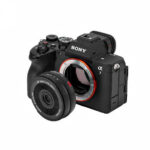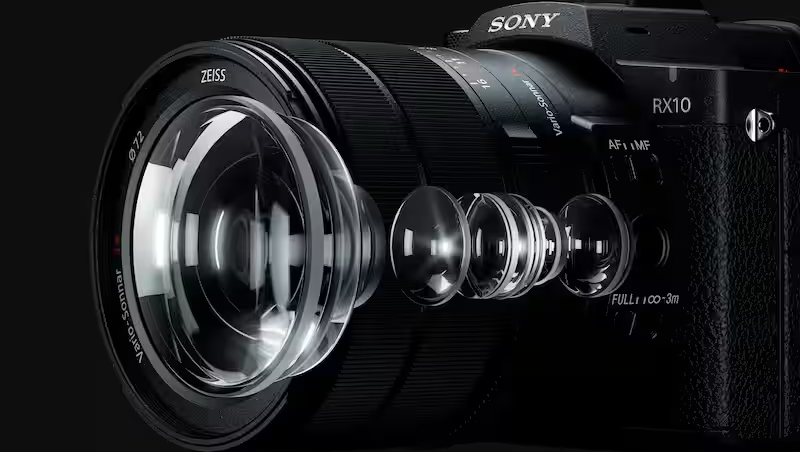
Sony announced the RX10 V on July 9, 2026, nine years after the Mark IV last updated the line. In that time, smartphones got smarter, full-frame mirrorless cameras got cheaper, and computing got faster. However, the RX10 V arrived with the same 20.1MP 1-inch stacked Exmor RS sensor and ZEISS Vario-Sonnar T* 24-600mm f/2.4-4 lens from 2017. Those are unchanged. The new processor, AI autofocus, and video upgrades are meaningful. The $2,299 price tag, though, invites a question that Sony probably hoped you wouldn’t ask: what exactly are you paying for at this point?
What a Bridge Camera Actually Is
Before getting into the RX10 V specifically, it helps to understand what a bridge camera exists to do. The term comes from the idea of bridging the gap between consumer point-and-shoot cameras and interchangeable-lens systems. Bridge cameras offer a fixed, permanently attached superzoom lens, which, in this case, 24mm to 600mm equivalent — in a body that looks and handles roughly like a DSLR. You get enormous reach without carrying a bag of lenses. Everything from a wide establishing shot to a tight bird-in-flight frame is available without changing anything. That is a genuinely useful proposition for a specific type of shooter.
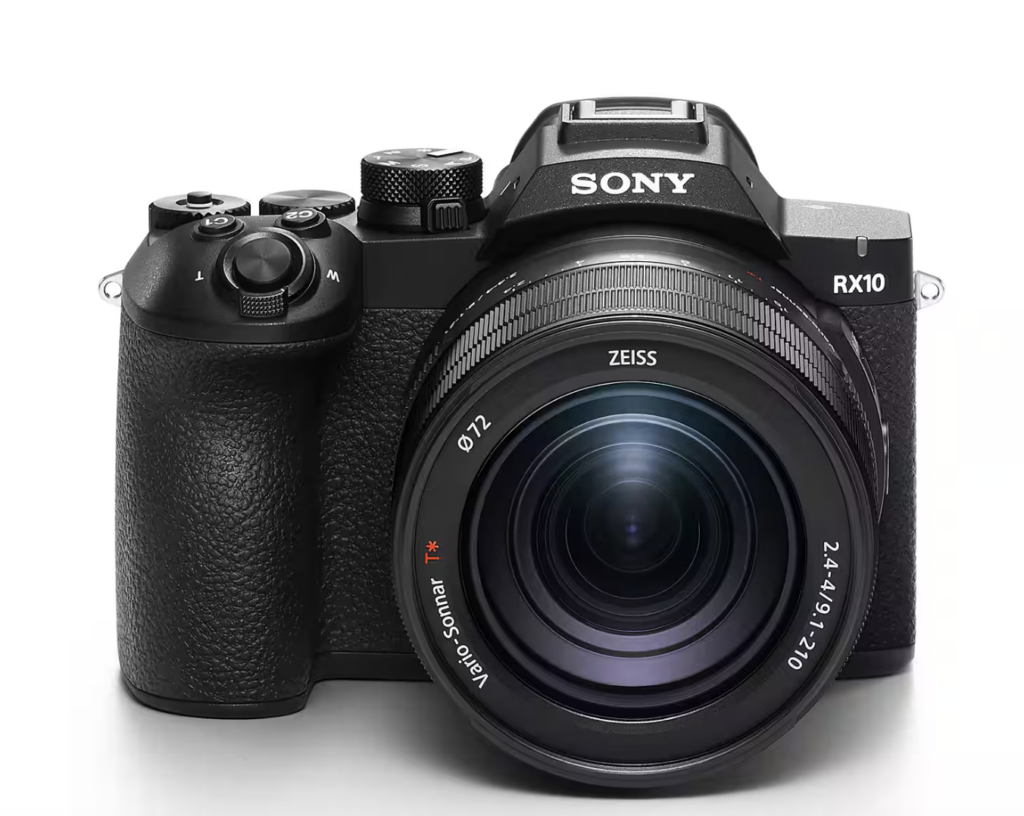
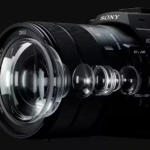
The RX10 series has always been the premium end of that category. Consumer bridge cameras from Nikon and Panasonic use tiny sensors and variable aperture lenses that turn dark in telephoto range. Unlike those, the RX10 uses a relatively large 1-inch sensor. It maintains f/2.4 at the wide end and f/4.0 at 600mm. That aperture control at 600mm equivalent is almost unique in the fixed-lens world. Furthermore, the ZEISS optics deliver a level of sharpness and rendering that outperforms what the sensor resolution actually demands. Optically, this lens was and still is extraordinary.
What Changed, and What Didn’t
The BIONZ XR2 processor is the most significant addition. It brings the RX10 V in line with Sony’s current Alpha camera generation, which consequently means real-time AI subject recognition for birds, insects, animals, and vehicles. Blackout-free continuous shooting now reaches 30fps with 60 AF/AE calculations per second, up from 24fps on the Mark IV. The video pipeline also gained real upgrades: 4K 60p 10-bit, 4K 120p slow motion, 1080p 240fps, S-Log3, and up to 16 custom LUT imports. For wildlife and sport videographers, these are substantial improvements.
Sony RX10 V – Key Specifications
| Sensor | 20.1MP 1-inch type stacked Exmor RS CMOS |
| Lens | ZEISS Vario-Sonnar T* 24-600mm equiv. f/2.4-4.0, OIS |
| Processor | BIONZ XR2 |
| Continuous Shooting | 30fps blackout-free, 60 AF/AE operations per second |
| Video | 4K 60p 10-bit, 4K 120p crop, 1080p 240fps, S-Log3, LUT import |
| Viewfinder | 0.39-inch OLED EVF |
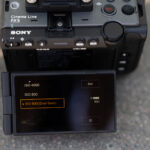
| Screen | 3-inch tilting LCD |
| Battery | NP-FW50 |
| Price | $2,299 |
However, the unchanged parts are harder to overlook at this price. The sensor is nine years old. It is a good 1-inch sensor. Compared to budget mirrorless cameras today, however, it shows its age in dynamic range, high-ISO performance, and pixel-level image quality. The rear screen tilts but does not flip out. In 2026, at this price, that is a peculiar omission given how many competing cameras offer fully articulating panels. There is also no built-in flash. DPReview noted that the $2,299 asking price aligns almost exactly with the RX10 IV’s 2017 launch price adjusted for CPI inflation. In other words, Sony priced this as though the nine-year gap simply didn’t happen.
The RX10 V answers a very specific question brilliantly. It just happens to be a question fewer and fewer people are asking in 2026.
Who This Camera Is Actually For
The RX10 V makes the most sense for a narrow but genuine group of photographers. Wildlife and bird-in-flight enthusiasts who prioritise reach above all else, shoot in good light, and want a single-body solution with no lens swapping involved. Wildlife videographers covering events like safaris or nature documentaries similarly benefit from the single-body convenience. Travel photographers who want one camera to cover everything from hotel room interiors at 24mm to distant architectural detail at 600mm also fit the profile well. For these specific use cases, nothing else in a fixed-lens body comes close to matching it.
The problem, however, is that $2,299 is no longer a price point that only competes with other bridge cameras. At that figure, you are competing with full-frame mirrorless bodies. That comparison is uncomfortable for the RX10 V.
The A7C II Conversation
The Sony A7C II launched in August 2023 at $2,199 — a hundred dollars less than the RX10 V. It carries a 33MP full-frame BSI sensor, the same BIONZ XR processor generation, AI autofocus, 4K 60p 10-bit video, and a fully articulating screen. That sensor is physically 7.4 times larger than the 1-inch chip in the RX10 V. In practical terms, expect dramatically better dynamic range. You also gain roughly two stops of usable high-ISO performance and more headroom in post when recovering shadows or highlights.
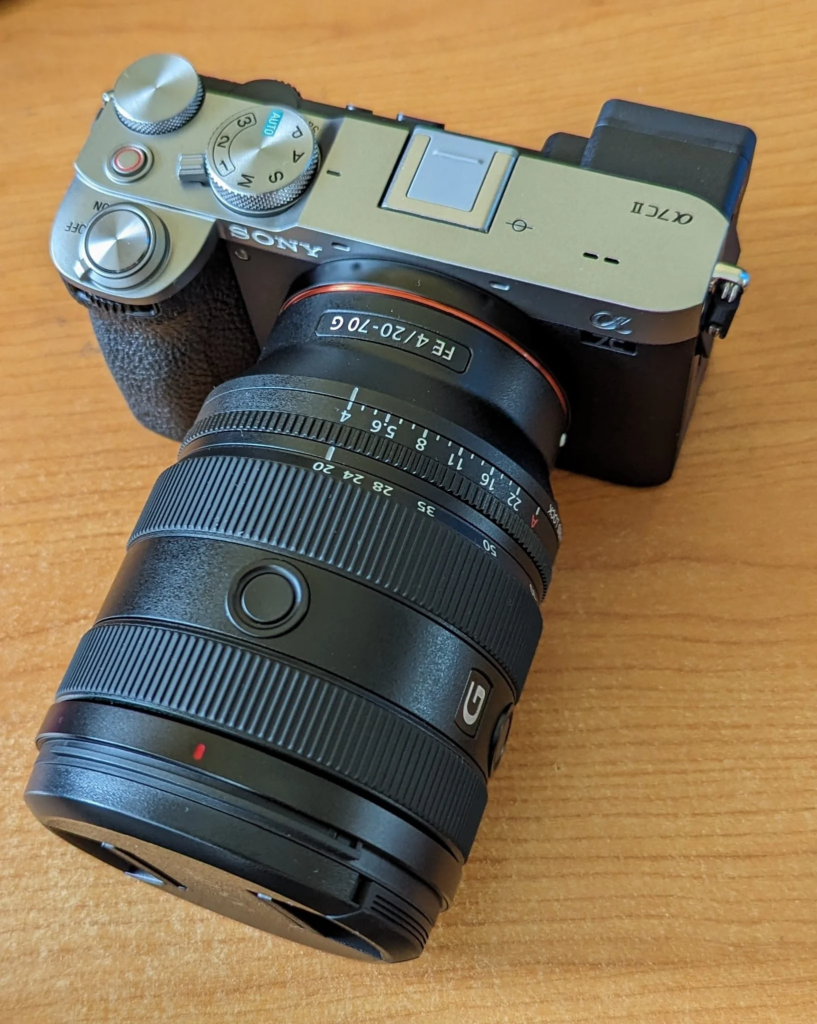
The trade-off is, of course, the lens situation. Buying the A7C II body only means you still need a lens. A Sony 200-600mm telephoto for comparable reach costs another $2,000. Combined, that is $4,200 for reach equivalent to what the RX10 V provides in one body. However, the A7C II plus a modest telephoto like the Tamron 150-500mm at $799 totals around $3,000. That combination delivers better image quality at every focal length. It also gives you a camera that swaps lenses for portraits, street work, or anything else you need. The RX10 V cannot do any of that. Furthermore, the A7C II opens you to the entire Sony E-mount ecosystem. As we covered recently, that is one of the deepest and most competitive third-party lens markets in the world.
None of this makes the RX10 V a bad camera. For the person who wants one body, one battery, and all-the-range-in-the-world without thinking about it, this is the only serious fixed-lens option in 2026. The AI autofocus, 30fps shooting, and 4K 120p video genuinely set it apart from the Mark IV. But at $2,299, Sony is asking you to pay flagship prices for a sensor that predates the last two iPhone generations. For a casual wildlife enthusiast, that is probably fine. For anyone serious about growing their photography, however, the A7C II is a more honest investment. It extends well beyond a single focal length.